Tile Adhesives That Protect a Premium Finish
A beautifully selected tile can still fail long before its time if the bond beneath it is wrong. Tile adhesives are rarely the feature a client sees, yet they carry the responsibility for a floor that feels solid underfoot, a bathroom wall that remains true, and a high-end finish that does not crack, drum or lose its alignment.
For homeowners, builders and project managers, adhesive selection should never be treated as a minor material choice. It is part of the installation system, working alongside substrate preparation, waterproofing, movement control and precise fixing. Get that system right and the finished surface has the quiet confidence of quality workmanship. Get it wrong and even exceptional tiles can become an expensive problem.
Why tile adhesives deserve more attention
Tiles do not simply sit on a surface. They expand and contract with changes in temperature, can be affected by moisture, and add significant weight to walls and floors. Large-format porcelain, natural stone and exterior pavers each place different demands on the adhesive beneath them.
The adhesive must achieve reliable contact with both the tile and the prepared substrate, while allowing for the small movements that occur in a building over time. It also needs to suit the environment. A kitchen splashback, a wet-room floor, an alfresco terrace and a busy commercial foyer may all be tiled, but they are not comparable installation conditions.
This is why a quality tiling scope starts before the first tile is laid. The condition of the base, the tile’s format and finish, exposure to water or heat, and expected foot traffic all influence the correct product and application method. Adhesive is not a substitute for preparation. It is the material that performs properly once preparation has been completed properly.
Choosing tile adhesives for the setting
The right adhesive is determined by the whole assembly, not by a single label on a bag. Cement-based polymer-modified adhesives are widely used because they offer strong bonding performance and flexibility across many residential and commercial applications. However, the degree of flexibility, setting time and suitability for demanding substrates can vary considerably.
Bathrooms, laundries and other wet areas
Bathrooms are unforgiving spaces. Moisture can find its way through grout lines and junctions, particularly where movement or poor sealing is present. Waterproofing protects the structure beneath the tile finish, while the adhesive provides the bond that keeps the tiled layer stable.
For wet areas, the selected adhesive should be suitable for the substrate and compatible with the waterproofing system. Compatibility matters. A premium result depends on each layer working together rather than competing with the next. Falls to waste, waterproofing details, coverage behind the tile and flexible sealing at changes of plane all contribute to a bathroom that looks refined and performs as intended.
Large-format tiles and porcelain slabs
Large-format tiles create a clean, architectural look with fewer grout joints and expansive visual flow. They also leave very little room for error. A small variation in the substrate can translate into lipping, hollow spots or uneven joints across a broad tile face.
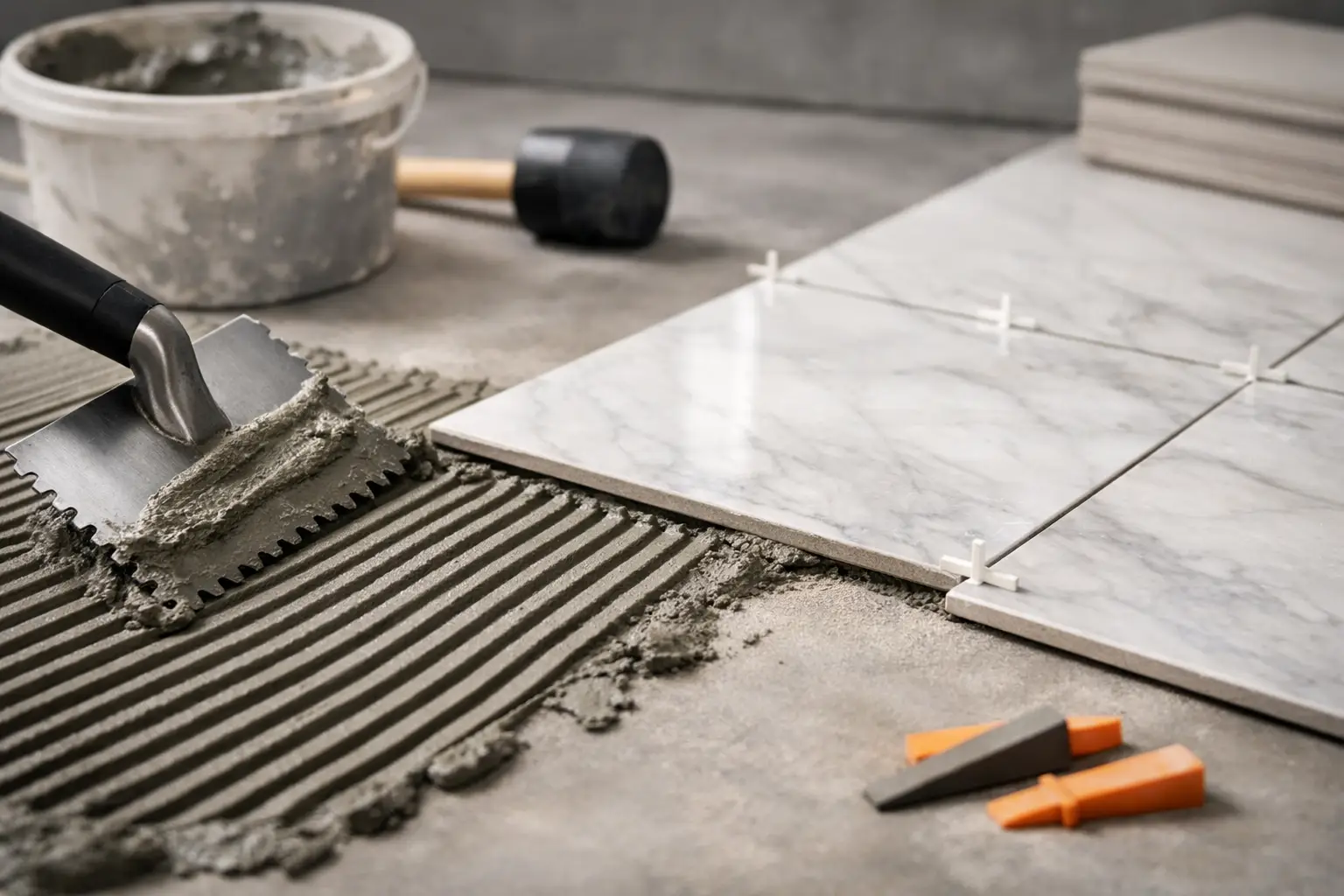
These installations generally require a highly workable adhesive with suitable flexibility and strong bond characteristics. The installation method is equally important. Adhesive is commonly applied to the substrate and the back of the tile to achieve thorough coverage. This is not an optional extra on large pieces. Incomplete contact can leave voids that make the tile vulnerable to cracking under load and may compromise the crisp, level finish clients expect.
Fast-setting products can assist where programme pressure is genuine, particularly on commercial or multi-unit work. But speed is not automatically an advantage. A quicker set leaves less time for adjustment, so the installer must have the preparation, labour planning and experience to work accurately within that window.
Natural stone and light-coloured finishes
Natural stone is valued for variation, depth and character. It also requires more careful material selection than standard ceramic tile. Some stone can be moisture-sensitive, translucent or prone to staining, meaning the wrong adhesive may affect its appearance through the face of the tile.
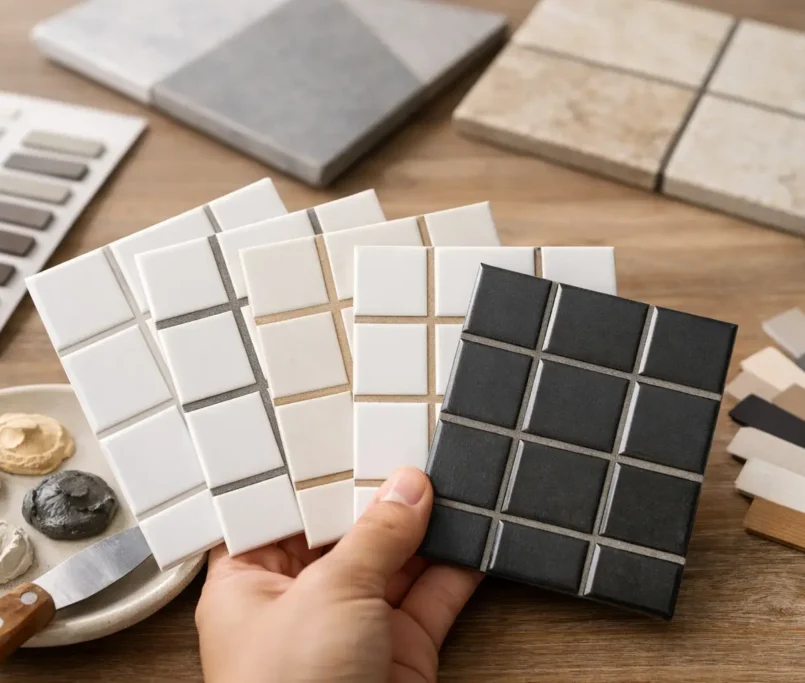
A white adhesive may be specified beneath light-coloured stone or pale porcelain to reduce the risk of shadowing or discolouration. The tile manufacturer’s guidance should be reviewed before work begins, particularly with marble, limestone and other porous materials. There is no benefit in investing in exquisite stone if the installation method risks undermining its natural beauty.
Exterior terraces, patios and alfresco areas
Outdoor tiling must cope with more pronounced temperature swings, rain, substrate movement and exposure to the elements. Water management is particularly critical. If water becomes trapped beneath tiles, repeated heating and cooling can place stress on the bond and increase the risk of failure.
An exterior-rated adhesive with suitable flexibility is only one part of the answer. The substrate must have correct falls, drainage must be considered, and movement joints need to be placed where they can do their job without interrupting the overall design. On balconies and elevated outdoor areas, waterproofing and detailing become even more consequential because failure can affect the spaces below.
The substrate decides more than most people realise
A tile adhesive can only bond as well as the surface it is applied to. Dusty concrete, old adhesive residue, loose screed, paint, moisture-affected timber or an uneven floor can all compromise the result. This is where shortcuts become visible later, usually after the project has already been handed over.
Concrete may need grinding, patching or levelling. Timber floors may need suitable sheet preparation and consideration of deflection. Existing tiles may be appropriate to tile over in limited circumstances, but only when they are sound, properly cleaned and assessed for height, weight and junction implications. Demolition and re-levelling can appear to add time at the outset, yet it often protects the programme by preventing rework later.
For large developments, consistency in substrate preparation is especially valuable. Repeated flat layouts do not guarantee repeated substrate conditions. A disciplined inspection process helps identify variations before they become repeated defects across dozens of units.
Coverage is the workmanship detail that cannot be faked
A tile can look perfect on the day it is installed while hiding inadequate adhesive coverage beneath it. This is one of the reasons workmanship matters as much as product selection.
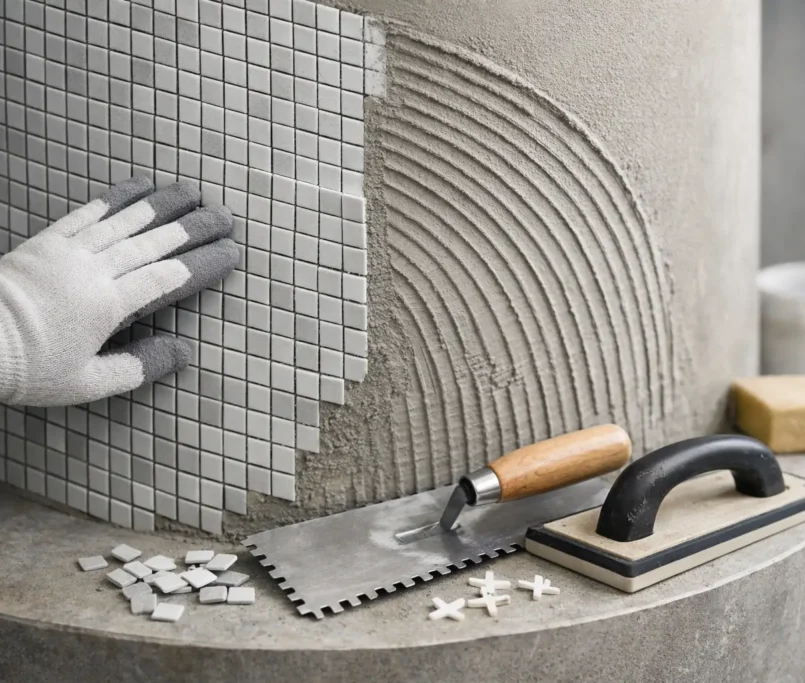
Correct trowel size, notch direction, adhesive consistency and bedding technique affect coverage. Tiles should be pressed and moved into the adhesive to collapse the ridges and form a continuous bond. For floors subject to regular load, exterior surfaces, wet areas and large-format tiles, full or near-full support is essential. Voids can create a hollow sound, concentrate load in weak points and permit water to travel where it should not.
The same discipline applies at edges, corners and tile cuts. Fine cuts and narrow pieces need adequate support, not a hurried application that leaves vulnerable points around fixtures, drains or thresholds. Precision is often invisible in the finished photograph, but it is what allows the photograph-worthy finish to last.
Movement joints are part of a premium finish
Tiles, adhesive, screed and building structures do not move at the same rate. Sun exposure, underfloor heating, structural settlement and vibration can all introduce movement. Without correctly planned movement joints, the tiled surface may relieve that stress through cracked grout, tented tiles or debonding.
Movement joints should be treated as a design and technical consideration from the beginning, especially across expansive floors, external areas and transitions between different materials. Flexible sealant at wall-to-floor junctions and around certain fixtures is not an afterthought. It is a controlled point of movement that protects the tiled field.
The trade-off is visual: joints can interrupt a continuous tile layout if they are poorly planned. A skilled tiling team considers tile set-out, thresholds, grout lines and room geometry so necessary joints are positioned as discreetly as possible without compromising performance.
Questions worth asking before tiles are fixed
A clear conversation before installation helps prevent assumptions from becoming defects. Ask what preparation is required, whether the selected tiles suit the intended space, and how waterproofing, adhesive and movement joints will work as one system. If the project includes large-format tiles, natural stone, exterior areas or underfloor heating, ask specifically how those conditions change the fixing approach.
It is also reasonable to ask how the programme will be managed. Adhesive curing times, waterproofing stages and substrate levelling cannot be ignored simply to meet an arbitrary handover date. Professional scheduling accounts for these steps while keeping the work moving with clear communication and accountable coordination.
At Perfectly Laid, the focus is not simply on placing tiles neatly. It is on building the prepared, protected foundation that allows every line, surface and finishing detail to hold its standard over time.
When selecting tile adhesives, the best decision is rarely the cheapest bag or the quickest promise. Choose the system that respects the tile, the substrate and the environment it will live in. That is where a lasting finish begins.