The Best Grout for Shower Floors Explained
A shower floor is one of the least forgiving tiled surfaces in a home. It is constantly wet, regularly cleaned, walked on barefoot and expected to drain perfectly every day. That is why choosing the best grout for shower floors is not simply a colour decision. The grout must suit the tile, joint width, drainage design and the quality of the waterproofed base beneath it.
For most premium shower installations, the strongest starting point is a high-quality epoxy grout or a premium flexible cement-based grout specified for wet areas. Neither is automatically right for every project. The best result comes from choosing a system that works with the tile and then installing it with the same care given to screeding, waterproofing and falls.
Why shower-floor grout deserves more attention
Grout does not make a shower waterproof. That responsibility sits with the waterproofing membrane below the tile assembly. This distinction matters because even the best grout can stain, crack or look tired when the substrate moves, the floor holds water, or the wrong product has been forced into unsuitable joints.
Yet grout still has a demanding role. It supports tile edges, fills joints cleanly, contributes to the finished texture underfoot and helps the floor look considered rather than unfinished. On mosaic shower floors, where there may be hundreds of joints, grout becomes a major visual feature as well as a practical finish.
A well-executed shower floor has consistent falls towards the drain, cleanly cut tiles, even joint widths and a grout chosen for the conditions. If any one of those elements is compromised, the finished bathroom can lose its sense of precision quickly.
Best grout for shower floors: epoxy or cement?
Epoxy grout for maximum stain resistance
Epoxy grout is often the premium choice for shower floors, particularly in design-led bathrooms, heavily used ensuites and projects where easy cleaning is a priority. Unlike traditional cement grout, it is made with resins and fillers that create a dense, highly stain-resistant finish.
Its key advantage is low absorption. Soap residue, body oils, shampoos and cosmetic products are less likely to soak into epoxy grout than into standard cement-based alternatives. It is also highly durable, making it well suited to small-format porcelain mosaics and natural stone-look tiles with many grout lines.
For a busy family bathroom or a high-end development where long-term presentation matters, epoxy can protect the visual quality of the floor exceptionally well. It is available in a broad palette too, allowing the joints to blend quietly with the tile or create deliberate contrast.
The trade-off is installation. Epoxy grout has a shorter working window and must be washed off the face of the tile with discipline. If it is handled poorly, residue can be difficult to remove and the finish can look patchy. This is not a product to treat as an afterthought at the end of a tiling job. It demands experienced preparation, careful timing and meticulous cleaning.
Premium cement grout for a refined, practical finish
Modern cement-based grouts are not the basic products many homeowners remember from older bathrooms. Quality polymer-modified formulations are designed for wet areas, offer improved flexibility and are available in sophisticated colours and fine textures.
A premium cement grout can be an excellent choice for a shower floor where the tile, joint size and maintenance expectations are appropriate. It is generally easier to apply than epoxy, can deliver a beautifully even finish and is often more economical on large areas.
The limitation is porosity. Cement grout usually needs sealing where specified by the manufacturer, and it may require more ongoing care than epoxy. Pale grout on a frequently used shower floor can gradually show soap film or discolouration if cleaning is inconsistent. A slightly deeper grey, warm stone or tonal grout colour is often a more forgiving option without compromising the design.
For many residential projects, a quality cementitious grout installed over correct waterproofing and properly graded screed provides a durable, elegant result. The decision should be based on the whole shower specification, not on cost alone.
What matters more than the grout label
The product choice matters, but shower performance is built long before grouting begins. The floor must be prepared so water moves decisively to the waste. Puddling around a drain or along a wall leaves grout and tile surfaces wet for longer, encouraging soap build-up and making the space harder to maintain.
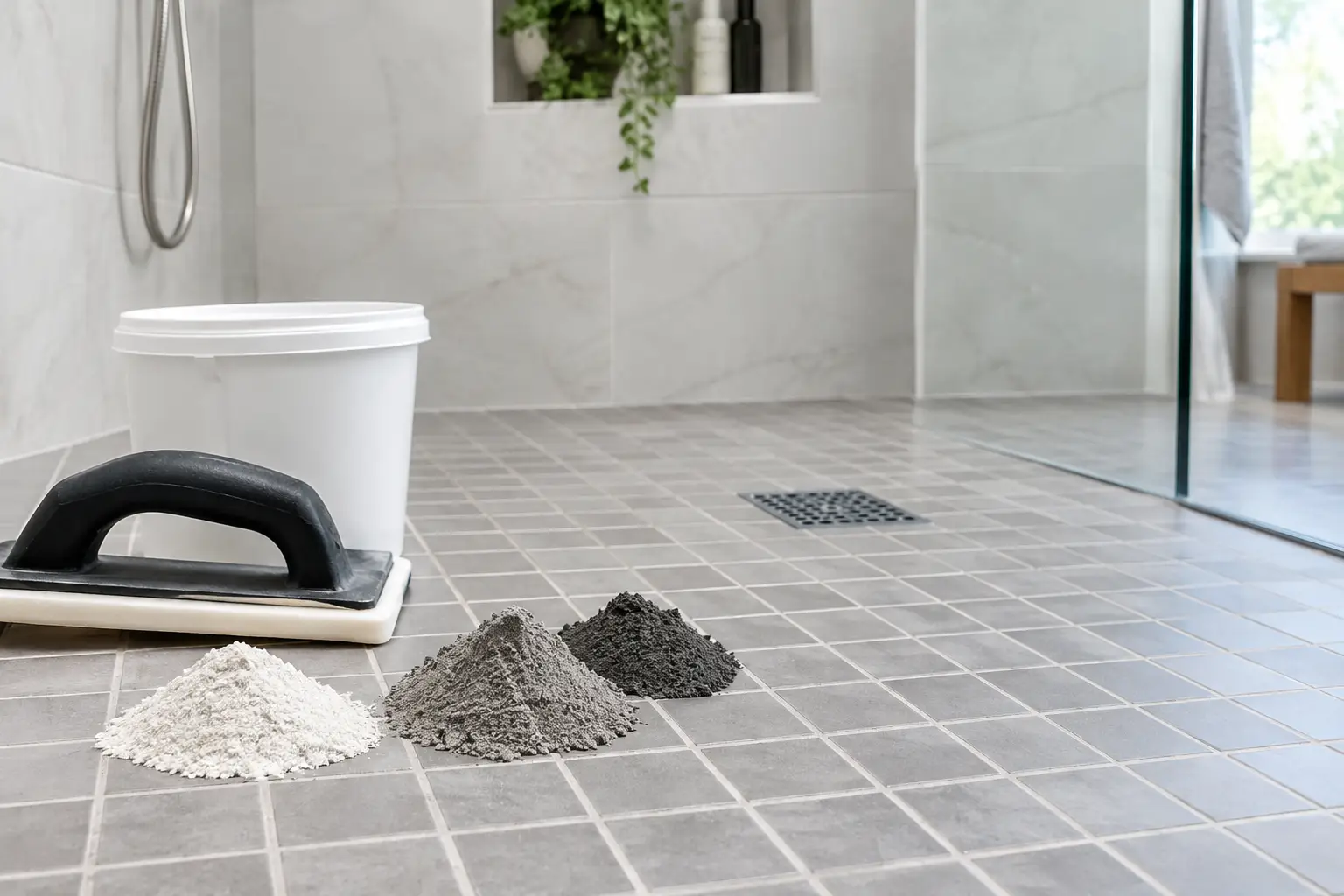
Tile selection also changes the conversation. Small mosaics are popular on shower floors because the additional joints improve slip resistance and allow the tile to follow falls more easily. However, more joints mean more visible grout. In this setting, a stain-resistant epoxy grout is often worth considering, especially with light-coloured mosaics.
Large-format tiles can create a striking, minimal shower floor, but they demand accurate screeding, considered drain placement and highly precise cuts. They also need enough fall to drain properly without making the tile surface uncomfortable underfoot. The grout may occupy less visual space, but the installation tolerances are tighter.
Joint width is equally relevant. Very narrow joints can look crisp, but only when tiles are rectified, the surface is flat and the installer can maintain consistency. Wider joints may be necessary for handmade, textured or irregular tiles. The grout must be compatible with the joint dimensions rather than selected solely from a display board.
Do not grout movement joints
The perimeter of the shower floor, internal corners and transitions between different materials are movement joints. They should not be filled with rigid grout. These areas require a high-quality sanitary silicone or another approved flexible sealant matched closely to the grout colour.
This detail is small but critical. Buildings move, substrates expand and contract, and showers experience regular changes in temperature and moisture. Grouting these junctions can lead to cracking and can create a pathway for water to reach areas it should not.
A precise silicone line also has an aesthetic value. When it is colour-matched, neatly tooled and limited to the correct locations, it protects the assembly without distracting from the tilework. This is the level of finishing that separates a merely tiled shower from a resolved bathroom.
Selecting grout colour for a shower floor
The most practical grout colour is rarely pure white. While white joints can suit a crisp, architectural scheme, they demand attentive cleaning and can make minor staining more obvious. A soft grey, mushroom, stone or tonal shade often gives a more enduring result, particularly on floors with texture or variation.
Matching grout closely to the tile creates a calmer, more expansive surface. This works beautifully with natural stone looks, terrazzo and large-format porcelain. Contrasting grout can define the geometry of mosaics or kit-kat tiles, but it will draw attention to every joint. It should be selected only where the layout and workmanship are precise enough to support that emphasis.
Always assess grout samples beside the tile in the actual bathroom lighting. A colour that looks subtle in a showroom can read cooler, darker or more prominent under the lighting used in the finished space.
A practical specification for lasting shower floors
For a typical porcelain mosaic shower floor, a high-quality epoxy grout is often the strongest performance-led specification, paired with colour-matched sanitary silicone at perimeter and change-of-plane joints. It is especially suited to light tiles, busy bathrooms and clients who want low-maintenance confidence.
For porcelain or ceramic tiles in a carefully designed residential shower, a premium flexible cement grout can be equally appropriate when it is suitable for wet areas, installed to the manufacturer’s requirements and maintained correctly. If natural stone is involved, both grout and sealer selection need extra care, as some stones can be sensitive to pigments, resins or cleaning products.
Whatever the material, avoid treating grout as the solution to a drainage or waterproofing issue. No grout can compensate for poor falls, an inadequately prepared substrate or an incomplete membrane. Those concealed layers protect the investment; the grout is the final, visible expression of work done properly.
The right grout should look effortless once the shower is complete. It should sit evenly between tiles, complement the material palette and stand up to daily use without becoming the feature you notice for the wrong reasons. That outcome comes from a considered specification and the precision to execute every layer beneath it.