Best Commercial Tiles for Heavy Traffic Areas
A busy entranceway tells the truth about a floor quickly. Grit from shoes, trolley wheels, wet weather, cleaning chemicals and thousands of daily footsteps will expose weak materials, poor preparation and rushed finishing. Choosing the best commercial tiles for heavy traffic is therefore not simply a design decision. It is a long-term investment in safety, appearance, maintenance and the reputation of the space itself.
For retail premises, hospitality venues, fitness facilities, schools, offices and multi-residential common areas, the ideal tile must do more than look exceptional on handover day. It needs to retain its finish under pressure, support a practical cleaning regime and sit on a substrate prepared to handle the demands above it. The most successful commercial floors combine material performance with precision installation from the ground up.
What makes a tile suitable for heavy traffic?
Traffic rating matters, but it should never be assessed in isolation. A tile may be hard-wearing on paper yet perform poorly if it is too smooth for a wet entry, poorly matched to the cleaning programme, or installed over an uneven or unstable base.
For heavily used commercial areas, look first at durability, slip resistance, water absorption, stain resistance and ease of replacement. The tile also needs to suit the setting. A hotel lobby and a commercial kitchen both receive intense footfall, but they face very different risks from moisture, grease, luggage, cleaning agents and acoustic expectations.
Porcelain is often the first choice because it has a dense body, very low water absorption and excellent resistance to scratching and staining. Yet the finish is as important as the material. A polished porcelain surface can be visually striking, particularly in a premium foyer, but may show marks more readily and offer less grip than a matt, structured or grip-rated alternative.
The installation system is equally critical. Correct screeding, levelling, adhesive selection, movement joints and edge detailing allow the tiled surface to perform as one considered system rather than a collection of individual pieces.
Best commercial tiles for heavy traffic by application
Through-body porcelain for entrances and corridors
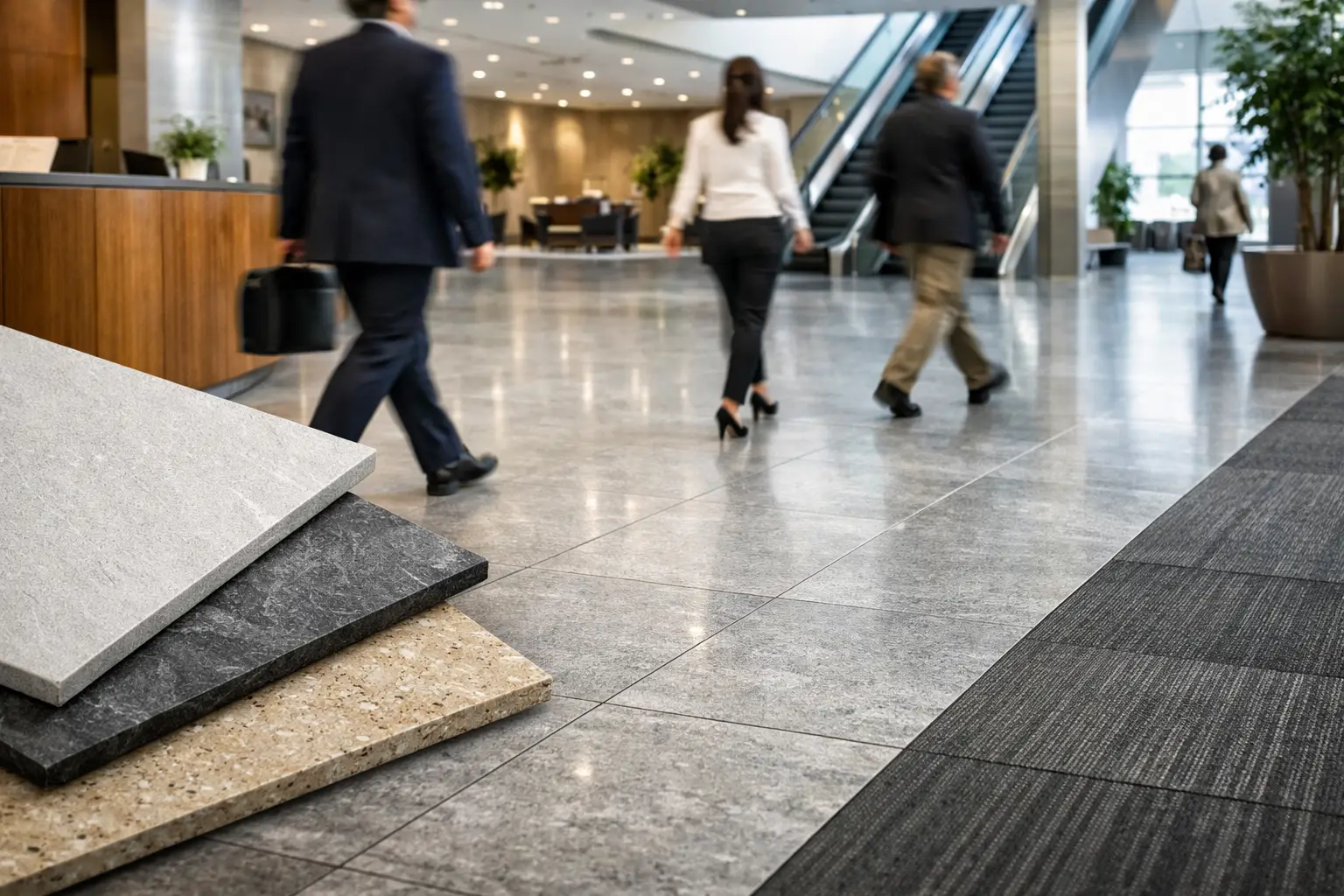
Through-body porcelain is among the most dependable choices for high-traffic public areas. Its colour and composition run through the tile body rather than sitting only on the surface, so minor chips or wear are less visually obvious. This makes it particularly suitable for corridors, retail floors, building lobbies, lift areas and busy reception spaces.
Choose a matt or lightly textured finish where wet footwear is likely. Large-format porcelain can create a refined, expansive appearance with fewer grout joints, which is valuable in design-led developments. However, larger tiles demand a very flat substrate. Even a small amount of lipping between adjacent tiles becomes more visible under feature lighting and can affect both appearance and cleanability.
For areas receiving dirt directly from outside, a considered entrance matting zone should work alongside the tile selection. Matting reduces abrasive grit at the door, helping protect the floor beyond it and reducing cleaning demands.
Grip-rated porcelain for wet or spill-prone spaces
Cafes, bars, leisure facilities, commercial bathrooms, pool surrounds and external walkways need a floor designed around slip resistance. In these locations, specify porcelain with an appropriate slip rating for the site conditions and the expected level of contamination.
A higher-grip tile usually has a more textured face. The trade-off is that deeper texture can hold dirt and require more thorough cleaning than a smoother tile. This does not make it the wrong choice. It means the finish must be selected with the operational reality of the site in mind.
For kitchens and back-of-house areas, chemical resistance and cleanability deserve close attention alongside grip. The right tile should withstand regular washing and the possibility of food, oil or cleaning-product spills without becoming difficult to maintain. Smaller formats can be useful in wet spaces, as additional grout lines may provide extra traction, although grout selection and sealing must be managed carefully.
Quarry tiles for demanding service areas
Quarry tiles remain a practical option for commercial kitchens, plant rooms, storerooms and other hard-working back-of-house environments. Their naturally durable, unglazed construction and textured finish suit areas where performance takes priority over a highly polished aesthetic.
They are not the natural answer for every project. Quarry tile can create a more utilitarian visual outcome, and its texture needs an appropriate cleaning approach. But where heat, moisture and intensive use are daily realities, it is a proven material with a place in a well-specified commercial scheme.
Natural stone for controlled premium environments
Natural stone can deliver an unmistakeably elevated result in hotel receptions, luxury retail settings and high-end residential common areas. It brings variation, depth and a sense of permanence that manufactured materials often imitate but cannot fully replicate.
However, stone is not automatically one of the best commercial tiles for heavy traffic. Softer stones can scratch, etch or stain, and many require regular sealing and a carefully managed maintenance programme. Honed granite or dense engineered stone may be suitable in select locations, while highly porous limestone or marble needs more caution in areas exposed to moisture, grit or food and drink.
The right question is not whether stone is luxurious. It is whether the client is prepared for the care it requires and whether the selected stone genuinely suits the building’s daily use. In many busy public zones, a premium porcelain with a convincing stone look offers a more predictable long-term outcome.
Do not overlook format, grout and edges
Tile format changes how a floor performs and how it feels. Large-format tiles reduce grout lines and can make a lobby, showroom or open-plan commercial space appear calm and expansive. They also reduce the amount of grout needing routine maintenance. Their success depends on accurate substrate preparation and experienced handling, particularly where patterns, feature bands or tight junctions are involved.
Smaller tiles are often better suited to bathrooms, ramps and areas requiring falls to drainage. They follow gradients more easily and provide more joint lines underfoot. Mosaic tiles can be highly effective in wet rooms, but they involve significantly more grout, so the grout specification must be suitable for regular commercial cleaning.
Grout colour should be chosen for more than visual contrast. Pale grout in a high-traffic café entrance may look pristine for a short time, then become an ongoing maintenance concern. A well-selected mid-tone grout can retain a refined appearance while disguising everyday wear more effectively. In demanding environments, epoxy grout may offer superior stain and chemical resistance, though it requires skilled installation and is not necessary for every application.
Edges, transitions and movement joints are where commercial tiling often succeeds or fails. Exposed corners need durable trims or carefully detailed mitres. Floor transitions must account for adjoining finishes, accessibility and trolley traffic. Movement joints should be incorporated where required rather than treated as an interruption to the design. They protect the installation from building movement and thermal change, which is far more valuable than an uninterrupted grid that later cracks.
The floor beneath the tile matters just as much
A premium tile cannot compensate for an unprepared substrate. Before installation begins, the floor should be assessed for flatness, moisture, cracking, contamination and movement. Demolition, re-levelling, screeding and waterproofing are not secondary tasks. They are the foundation of a finish that remains precise long after practical completion.
Moisture is a particular risk in ground-floor slabs, wet areas and newly constructed buildings. Installing tiles before moisture conditions are properly addressed can lead to adhesive failure, staining or movement issues. Likewise, attempting to correct major floor irregularities with adhesive rather than proper levelling is a false economy that can compromise the final result.
At Perfectly Laid, this preparation-led approach is central to commercial delivery. Material selection is only one part of protecting the outcome. The workmanship behind the surface determines whether the space opens cleanly, performs reliably and continues to reflect the quality expected by owners, operators and visitors.
Specify for cleaning, not just for handover
The right commercial floor should be straightforward for the facilities team to care for. Before finalising the tile, consider the equipment and products likely to be used. Will the floor be cleaned by hand, with a scrubber dryer, or through a contracted cleaning programme? Will the area face harsh disinfectants, grease, street dirt or frequent water exposure?
Ask for samples and assess them in the actual lighting conditions of the project. A dark matt tile may hide dirt beautifully but show dust in direct sunlight. A very pale textured tile may suit the design palette yet demand more frequent attention. These are not reasons to avoid a particular finish, but they are decisions that should be made openly before procurement and installation.
It is also sensible to order spare tiles from the same batch. Even the toughest floor can be damaged by a dropped object, a building alteration or a service repair. Keeping replacement stock makes a localised repair far more likely to blend with the original installation.
A floor that earns its place every day
The best choice balances visual ambition with the real behaviour of the space. Dense, grip-appropriate porcelain will be the strongest all-round answer for many commercial projects, while quarry tile, stone and specialised finishes each have a role where their strengths match the brief.
Start with how people will use the space at its busiest and messiest, then work backwards through safety, maintenance, substrate preparation and design. When those details are resolved with care, the finished floor does more than withstand traffic. It gives every visitor a quiet, lasting impression of quality.