Do I Need Expansion Joints in Tiling?
A tiled surface can look flawless on day one and still fail months later for a reason most people never see coming – movement. If you are asking, do I need expansion joints in tiling, the short answer is yes, in many cases you do. They are not an optional extra for difficult sites or large commercial builds only. They are a critical part of a tiled system that is expected to stay flat, sound, and beautifully finished over time.
The mistake is thinking tiles and grout form a rigid skin that should never move. In reality, buildings move, substrates expand and contract, sunlight heats surfaces unevenly, and moisture can change dimensions. Precision tiling is not just about straight lines and neat cuts. It is about allowing controlled movement so the finish remains intact.
Why expansion joints matter in tiling
Tiles themselves are hard-wearing, but the assembly beneath and around them is constantly under pressure. Concrete cures and shrinks. Timber floors flex. Heated screeds warm up and cool down. External areas face sun, rain, and temperature swings. Without movement accommodation, that stress has to go somewhere.
Usually, it shows up as cracked grout, drummy tiles, tenting where tiles lift away from the floor, or fractured edges around perimeters. In more severe cases, whole sections can debond. That is why expansion joints are not simply about compliance. They protect the visual finish, the long-term durability of the installation, and the investment behind it.
For homeowners, that means avoiding the frustration of a premium bathroom or alfresco area developing faults long after the renovation is finished. For builders and developers, it means reducing defects, call-backs, and programme disruption across multiple units.
Do I need expansion joints in tiling for every project?
Not every tiled area needs the same movement joint layout, but every project should be assessed for movement. That distinction matters.
A small splashback in a stable internal setting is very different from a large-format porcelain floor across an open-plan kitchen, or an outdoor entertaining area exposed to direct afternoon sun. The need, spacing, and placement of joints depend on the substrate, tile format, setting materials, location, exposure, and the size of the tiled field.
So if the question is do I need expansion joints in tiling, the more accurate answer is this: if the tiled surface is large, exposed, interrupted by structural movement, or installed over a substrate that moves, then movement joints are essential. Even in smaller spaces, perimeter and junction movement gaps are often necessary.
Where expansion joints usually need to go
This is where good tiling separates from basic tile laying. A proper movement strategy is planned, not improvised once the adhesive is down.
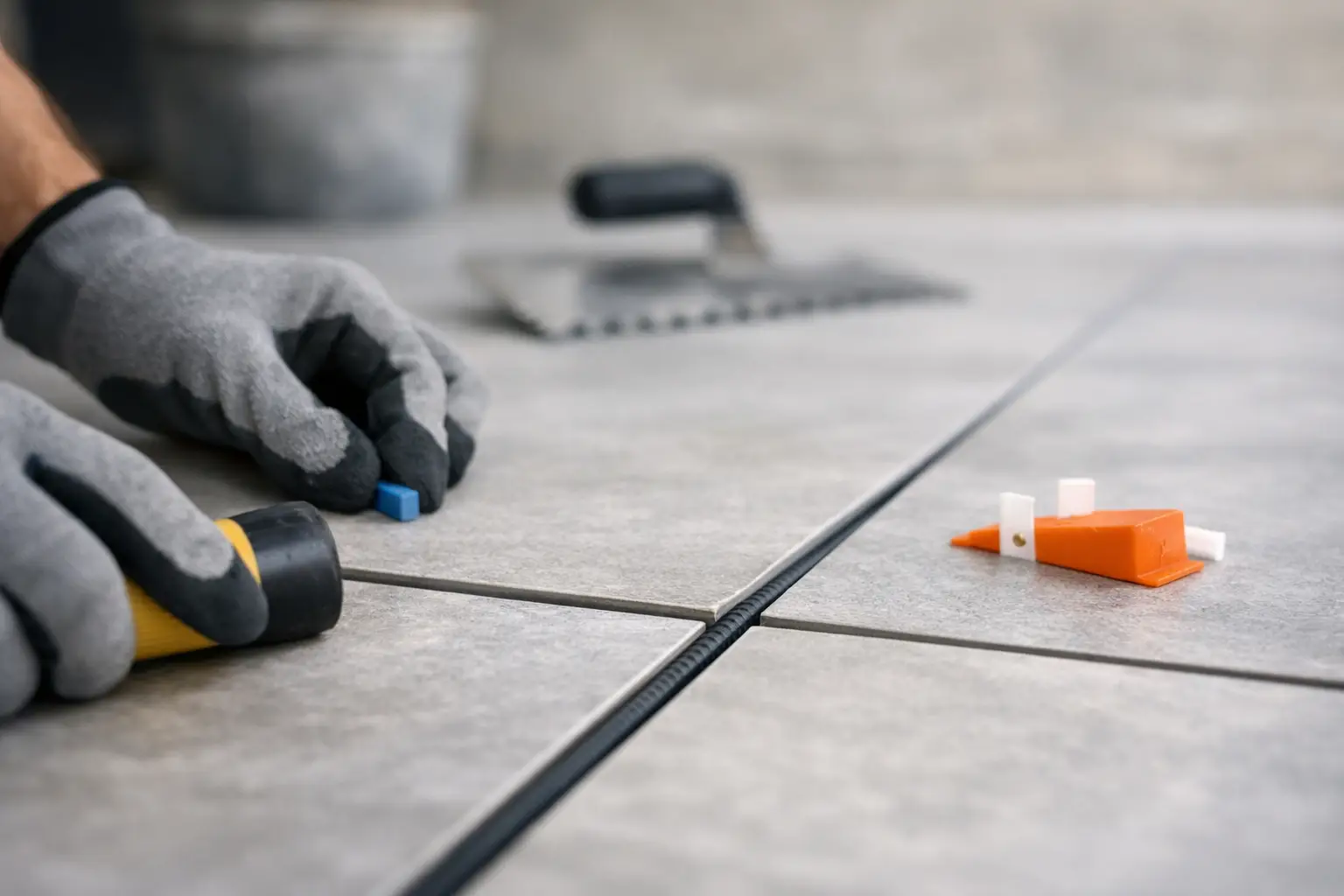
Perimeter joints are commonly required where tiles meet walls, columns, cabinetry, thresholds, and other restraining surfaces. These edges should not be locked hard with grout, because that traps movement within the tile field.
Movement joints are also needed over existing structural or construction joints in the substrate. A tile finish should never bridge a live joint and hope for the best. If the slab or screed is designed to move at that point, the tile assembly must respect it.
In larger tiled areas, intermediate joints may be required within the field itself. The exact spacing depends on whether the area is internal or external, whether it is subject to direct sun, and the underlying substrate conditions. External areas generally require more conservative joint spacing because thermal movement is greater.
Changes in plane matter too. Where a wall meets another wall, or a wall meets a floor, that junction is better handled with an appropriate flexible sealant rather than rigid grout. It gives the installation room to move while keeping the finish clean and deliberate.
The projects where people most often get this wrong
Bathrooms can seem small enough to ignore movement, but the combination of moisture, waterproofing systems, heated floors, and junctions at walls and shower trays means detailing still matters. Problems often appear not in the middle of the room, but at the corners and edges where rigid finishes are forced together.
Kitchens and open-plan living areas are another common trouble spot, especially with large-format tiles running through wide spaces. The cleaner and more minimal the design, the more tempting it is to avoid visible joints. But hiding movement at the expense of performance is false economy.
Outdoor tiling is where shortcuts are punished fastest. Patios, balconies, and alfresco spaces absorb heat, cool rapidly at night, and deal with moisture constantly. If movement joints are omitted or poorly positioned, tiles can crack or tent with surprising speed. In high-end exterior work, movement planning is every bit as important as tile selection and falls.
Commercial fit-outs and multi-unit developments add another layer. Repetition can create the illusion that one standard detail fits every area. It rarely does. Lift lobbies, amenities, retail frontages, and podium or balcony zones all behave differently. Consistency in finish only comes from disciplined assessment of each condition.
What happens if expansion joints are skipped?
Sometimes nothing obvious happens straight away, which is exactly why they are overlooked. A floor can appear perfect at handover and still be under stress from day one.
Over time, that pressure starts to reveal itself. Grout lines may crack first. Hollow-sounding tiles can follow. Edges chip as tiles press against each other. In more serious cases, the tiled field lifts in a ridge or releases from the substrate. Repairs are rarely neat, and they are almost never limited to one tile.
There is also an aesthetic cost. Premium tiling should feel calm, level, and intentional. Failures caused by movement undermine that finish completely. In design-led spaces, even minor cracking can spoil the overall impression.
Can expansion joints still look refined?
Yes – when they are planned properly.
One reason clients hesitate is the fear that movement joints will interrupt the visual flow. Poorly handled joints can do that. Well-executed ones do not. They can be aligned with grout lines, located at logical transitions, integrated at perimeters, and finished with colour-matched flexible sealants that sit quietly within the scheme.
This is where craftsmanship matters. Expansion joints should not look like an afterthought or a compromise. They should be detailed as part of the design language of the space. On high-specification residential and commercial projects, that level of control is what preserves both performance and appearance.
Expansion joints are only one part of the movement story
It would be misleading to treat joints as a cure-all. A tiled installation also depends on the right substrate preparation, correct adhesives, suitable tile backing, proper screeding, waterproofing where required, and accurate installation methods. If the base is unstable or the materials are mismatched, movement joints alone will not save the project.
That is why end-to-end execution matters. Surface preparation, levelling, substrate assessment, and finishing details all contribute to whether the system performs as intended. Expansion joints are one visible sign of technical discipline, but they work best as part of a complete approach.
When expert advice is worth it
If the tiled area is external, unusually large, exposed to direct sunlight, installed over underfloor heating, or part of a commercial or multi-residential project, it is worth having the movement strategy considered before installation begins. The same applies if you are using large-format tiles or aiming for a very minimal joint layout.
For clients investing in a premium finish, movement planning should happen early, alongside tile selection and set-out. It is far easier to integrate joints elegantly at the design stage than to repair a failed installation later. This is one of the reasons specialist contractors such as Perfectly Laid place so much emphasis on disciplined preparation and finishing details. The best-looking tiled spaces are usually the ones where the unseen technical decisions were made properly from the start.
A beautiful tiled surface is not one that resists movement at all costs. It is one that accommodates movement with precision, so the result stays crisp, durable, and true to the design long after the project is complete. If you are weighing up whether expansion joints are necessary, treat them as protection for the finish you want to keep, not a disruption to the look you are trying to achieve.