Tiling for Luxury Developments That Holds Up
A luxury development is judged in the moments buyers and residents experience at close range: the clean line where stone meets a shower niche, the consistency of grout joints across a lobby floor, the solid feel beneath foot in a penthouse bathroom. Tiling for luxury developments is where the architectural promise either becomes tangible or begins to unravel. Exceptional tile can never compensate for poor preparation, rushed setting-out or finishing details left to chance.
For developers, builders and project managers, the challenge is bigger than achieving one impressive display suite. It is delivering the same controlled standard across every residence, shared space and external area while protecting the programme. That calls for a tiling partner with disciplined processes, clear communication and the craftsmanship to resolve complex details before they become expensive defects.
Luxury is Built Into the Substrate
The visible tile is only the final layer of a much larger system. On high-end projects, the quality of surface preparation determines whether large-format porcelain sits flat, natural stone reads as a continuous plane, and floor falls direct water precisely where they should go.
Substrates are rarely perfect when a tiling team arrives. Concrete can vary in level, walls may be out of plumb, and transitions between trades can create awkward changes in height. Treating these conditions as minor site issues is a false economy. They affect tile lippage, adhesive coverage, drainage, movement and the finished alignment of joinery, screens and fittings.
A quality-first scope begins with inspection and honest assessment. Where required, this may mean demolition of unsuitable finishes, re-levelling, screeding and careful correction of wall planes before tile installation starts. It can feel slower at the outset, but it prevents the familiar late-stage scramble: cutting down tiles to meet an uneven threshold, forcing a shower fall into an inadequate depth, or accepting inconsistent joints because the room was never properly set out.
Luxury clients notice order. Flat surfaces, balanced cuts and crisp interfaces create that sense of calm because every element appears intentional.
Waterproofing Is Not a Hidden Extra
Bathrooms, laundries, balconies and wet commercial areas demand a waterproofing approach that is compatible with the substrate, tile system and intended use. This is not an invisible task to be delegated without scrutiny. If waterproofing fails, the most beautiful finish becomes the most costly part of the project.
Proper preparation includes managing penetrations, junctions, corners, drains and changes of plane with care. It also requires sequencing with plumbing and other trades so the membrane is not compromised after it has been installed. On multi-unit developments, consistency matters just as much as individual workmanship. A repeatable process, documented checks and accountable supervision help ensure that unit 87 receives the same attention as the showpiece flat on level one.
Setting Out Creates the Premium Look
The difference between competent tiling and an exquisite result often appears before the first tile is fixed. Setting out establishes where cuts will fall, how joints align through doorways, whether feature walls feel centred and how floor tiles relate to cabinetry, sanitaryware and linear drains.
In a luxury bathroom, a poorly planned layout can leave a narrow strip of tile beside a vanity or an off-centre niche that catches the eye every day. In a lobby, it can create visibly uneven perimeter cuts that undermine an otherwise refined material palette. These are not material problems. They are planning problems.
A skilled tiling contractor reviews elevations, tile sizes, batch variations and room dimensions early enough to advise on practical adjustments. Sometimes the design intent supports a full-height slab look with minimal joints. Sometimes a smaller module is the wiser choice because it manages falls, movement and room geometry more effectively. The right answer depends on the material, the location and the performance required, not simply on what looks best in a sample board.
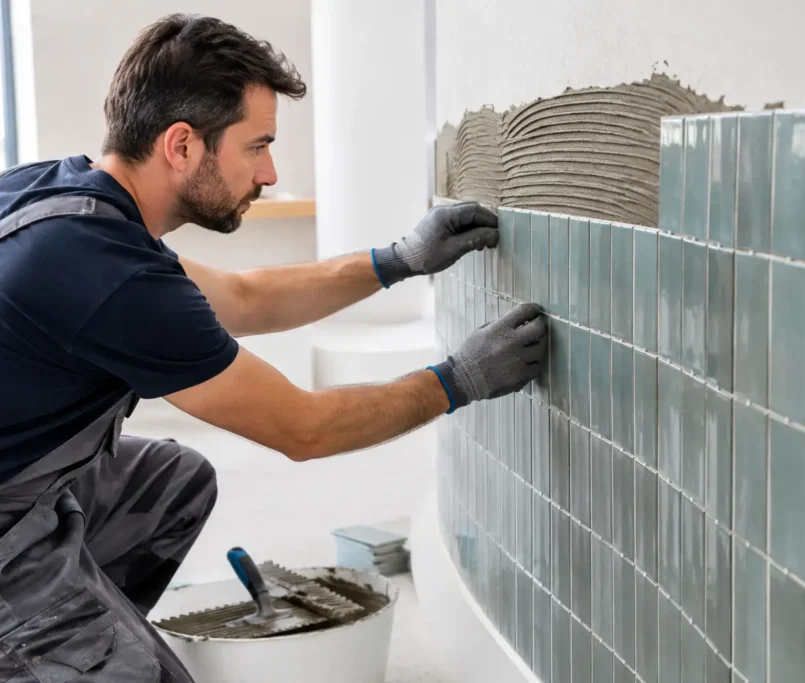
Large-format tiles and porcelain slabs deserve particular care. They bring scale and visual continuity, but demand exceptionally flat backgrounds, suitable handling equipment, precise adhesive application and experienced installers. A small error becomes more visible as tile size increases. This is one area where the cheapest labour price can quickly become the most expensive decision.
Consistency at Scale Without Losing Craftsmanship
A development may include dozens or hundreds of bathrooms, kitchens, balconies, corridors and amenities. Repetition creates efficiency, yet it also magnifies mistakes. A detail that is missed in one prototype can be repeated across an entire building.
The strongest delivery model combines a carefully approved benchmark with practical production control. Early units should be used to confirm tile layout, grout colour, trim selection, falls, silicone junctions and acceptable finish standards. Once agreed, those decisions need to be carried across the programme with regular quality checks rather than assumed compliance.
For high-rise delivery, coordination is central. Tile supply needs to arrive in the correct sequence and be protected on site. Access, lift bookings, waste removal and work fronts must be planned around other trades. The tiling team must also communicate quickly when an issue threatens the programme, whether that is a damaged batch, an incomplete substrate or a late design change.
Perfectly Laid approaches this work as an end-to-end trade package, from surface correction and waterproofing through to precise installation, grouting and caulking. That continuity reduces handover gaps and gives project teams a clearer line of accountability. For developments of up to 200 units, it also supports the consistency that buyers expect from a premium address.
Details That Separate a Good Finish From a Great One
High-end tiling is rarely defined by one dramatic gesture. More often, it is the accumulation of small decisions made correctly. Mitred external corners may create a sharp, monolithic appearance, but only where the material and location suit the detail. Metal trims can offer greater resilience in busy areas and should be selected to complement, rather than distract from, the scheme.
Grout selection deserves the same attention. A close colour match can make a tiled surface feel expansive, while a contrasting grout turns the joint pattern into a design feature. Neither is automatically superior. Light grout in a heavily used café or fitness setting may require more maintenance, whereas a considered mid-tone can retain its appearance for longer. The use case should guide the specification.
Silicone and caulking are also part of the finished aesthetic, not a last-minute clean-up task. Neat, colour-matched joints at changes of plane allow for movement while giving bathrooms, kitchens and external spaces a composed finish. Uneven beads, gaps or unsuitable products can diminish even the finest stone.
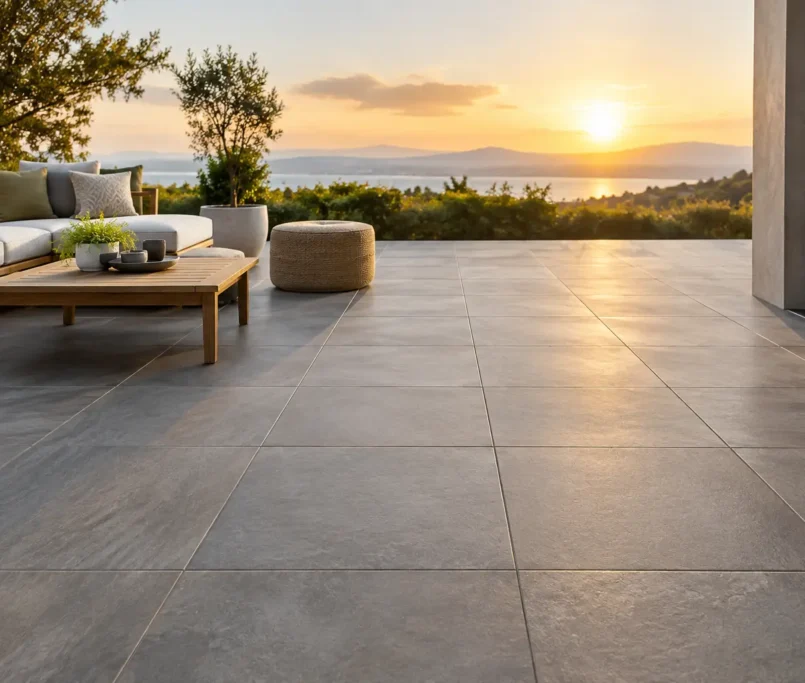
External tiling brings further considerations. Slip resistance, drainage, movement, exposure to weather and substrate stability all need to be considered before choosing a finish. A beautiful alfresco surface that holds water or becomes difficult to walk on when wet is not a luxury outcome. It is a design and installation failure.
Protecting the Programme and the Asset
Premium developments carry high expectations, but they also carry commercial pressures. Delayed tiling can hold up joinery, shower screens, appliance installation, cleaning and final inspections. Conversely, pushing installation before backgrounds are ready risks remedial work that costs more time than it saves.
The answer is not speed at any cost. It is reliable sequencing, sufficient skilled labour and responsive site management. A professional tiling contractor should provide clear scope boundaries, identify risks early and maintain the quality of completed work as surrounding trades continue. Protection of finished surfaces is especially important on busy sites, where a completed bathroom can be damaged long before practical completion.
For developers, this protects more than the construction programme. It protects reputation. Purchasers may not know the technical language of screeds, membranes or movement joints, but they recognise a floor that sounds hollow, a shower that drains poorly or a tile edge that feels rough. Those details shape defect lists, handovers and referrals long after the project is complete.
Choosing a Tiling Partner for a High-End Development
The right contractor should be assessed on more than a square-metre rate. Ask how they inspect substrates, manage waterproofing, set out rooms and maintain standards across repeated unit types. Review the quality of their finishing details and their ability to coordinate with project managers, designers and adjacent trades.
Capability should match the scale of the work. A boutique development may benefit from highly detailed, hands-on oversight, while a larger residential project needs the labour planning and operational systems to maintain momentum across many floors. In both cases, responsiveness matters. Problems are inevitable on construction sites; what separates a dependable trade partner is how quickly and transparently those problems are addressed.
The most valuable tiling work is often the work nobody has to think about after handover. Floors sit true, water drains correctly, joints remain clean and every room carries the same assured standard. That quiet confidence is what turns a premium specification into a lasting part of the development’s value.