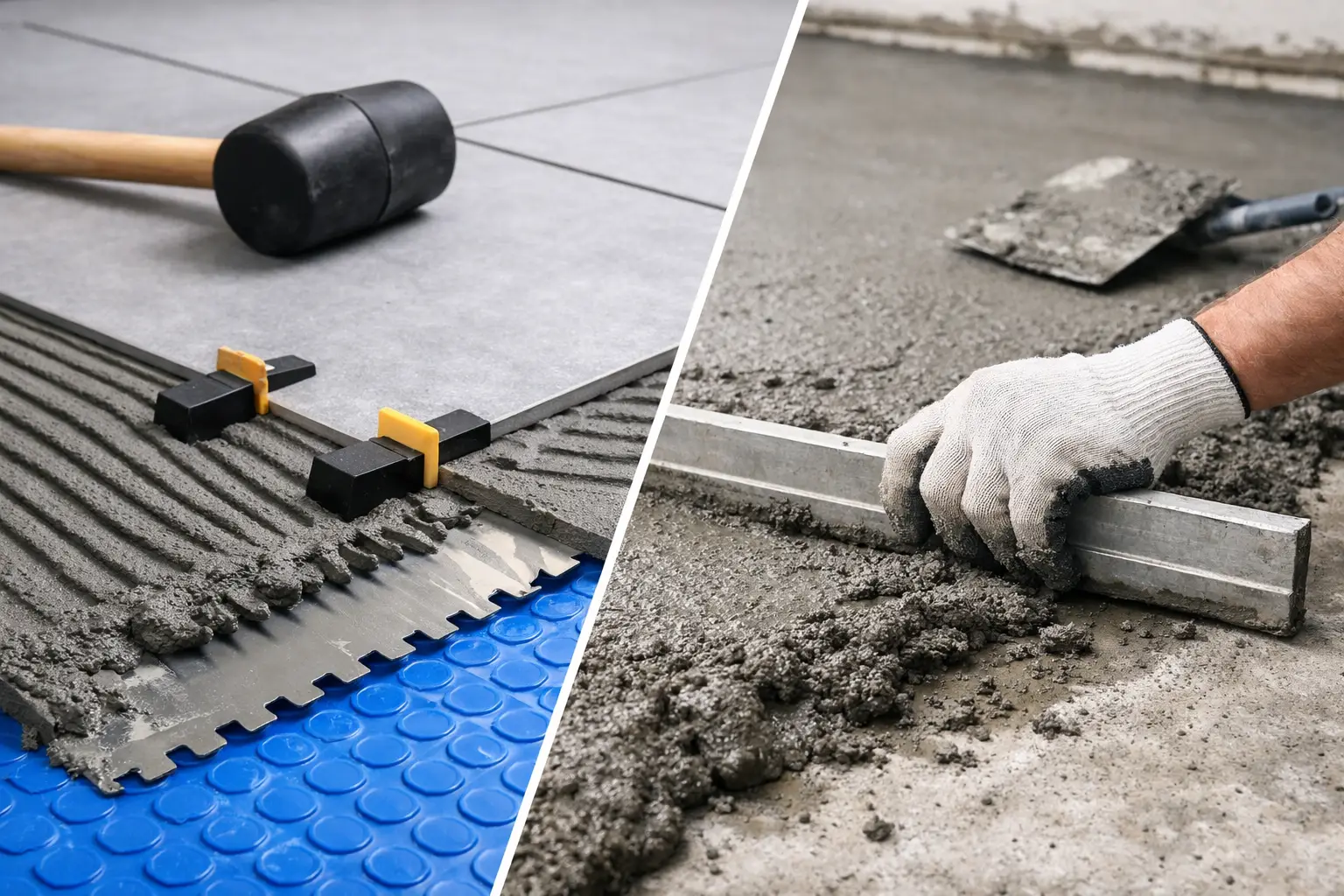
Tile Underlay vs Screed: Which One Fits?
If you are weighing up tile underlay vs screed, the real question is not which product is better in the abstract. It is which substrate preparation method gives your project the stability, level finish and long-term tile performance it actually needs. Get that decision right, and the tiled surface looks refined and stays sound. Get it wrong, and even beautiful tiles can be let down by movement, lipping, cracking or drainage issues.
For homeowners, builders and project managers, this choice often appears late in the planning stage, when the finish line feels close. In practice, it should be considered much earlier, because underlay and screed do very different jobs. They can affect floor height, curing time, waterproofing build-up, final falls and the quality of the installation that sits on top.
Tile underlay vs screed – what is the difference?
Tile underlay is a board or sheet product fixed over an existing substrate to create a suitable tiling surface. It is commonly used over timber floors and certain internal substrates where the goal is to improve rigidity and provide a stable base for adhesive and tile. Think of it as a controlled layer that helps prepare the surface without reshaping the floor in any major way.
Screed is a cement-based layer applied to a floor to level it, build falls, correct unevenness or create the right base for tiling. It is far more than a surface cover. A properly installed screed can reshape the floor plane, address depressions and high spots, and provide the consistent levels required for a premium finish.
That distinction matters. Underlay follows the existing floor more closely. Screed can correct it.
When tile underlay makes sense
Tile underlay is often the right answer when the substrate is structurally sound but not ideal for direct tiling. In many internal renovation settings, especially over timber flooring, underlay offers an efficient way to create a tile-ready surface without the weight and build-up associated with screed.
This can be particularly useful where floor heights are tight. If doors, joinery, transitions or fixture clearances leave little room to build up the floor, an underlay system may preserve more of the existing levels. It can also suit projects that need a faster programme, since there is no screed curing period in the same sense as a traditional wet-laid system.
That said, underlay is not a shortcut for a poor substrate. If the floor beneath is flexing, significantly out of level or carrying moisture-related issues, laying board over the top does not solve the underlying problem. It simply covers it until the tile finish starts showing the consequences.
Best uses for tile underlay
Underlay tends to perform well in dry internal areas, upper-storey renovations and projects where the existing floor is reasonably even but needs a more suitable surface for tiling. It can also be practical in some bathroom and laundry builds, provided the full system is designed correctly and waterproofing is handled with precision.
The key phrase there is full system. Tiles do not succeed because one product was chosen. They succeed because substrate prep, movement control, waterproofing, adhesive selection and installation detail all work together.
When screed is the better choice
Screed comes into its own when the floor needs correction rather than just coverage. If a slab is uneven, if the room requires falls to waste, or if the design calls for large-format tiles that demand tighter tolerances, screed is often the more reliable path.
Bathrooms are a common example. Where drainage matters, falls need to be deliberate and consistent. A screed bed allows the installer to create those falls with accuracy rather than trying to force the result with adhesive. The same principle applies to balconies, alfresco zones and other outdoor areas, where water management is not a cosmetic issue but a durability one.
Screed also suits premium projects where visual perfection matters. When you are laying rectified porcelain, natural stone or large-format tiles, small irregularities in the substrate become very visible. A well-finished screed helps achieve cleaner lines, flatter tile planes and a more composed final look.
Where screed earns its keep
Screed is often the stronger option for new builds, wet areas, external spaces and commercial works where consistency across larger floorplates matters. It is also valuable on projects with mixed conditions, where one room may need levelling and another requires formed falls.
For builders and developers, this becomes a quality control issue as much as a technical one. Standardising the substrate properly upfront usually leads to fewer installation compromises later.
The trade-offs clients should understand
There is no honest tile underlay vs screed comparison without talking about trade-offs. Underlay can be quicker and lighter, but it has limited ability to correct level issues. Screed offers more control and can dramatically improve the substrate, but it adds wet trade sequencing, curing time and often more labour.
Cost is another area where assumptions can be misleading. Underlay may appear cheaper at first glance, yet if the floor still needs significant correction, the savings can disappear quickly. Screed may cost more initially, but if it prevents failures, improves finish quality and reduces on-site compromise, it can be the more economical decision over the life of the floor.
Height build-up also matters. In renovations especially, every millimetre counts. Thresholds, appliances, skirtings and existing adjoining finishes can all influence the viable preparation method. A good tiling contractor will assess the whole floor assembly, not just the tile surface.
Why the substrate matters more than the tile itself
Clients understandably spend time choosing tile colour, format and layout. Yet the hidden layers below are what protect that investment. A premium tile installed on a poor substrate will never perform like a mid-range tile laid over a properly prepared base.
This is where experienced trade judgement makes a difference. The decision between underlay and screed is not made in isolation. It sits alongside deflection, moisture, room use, load expectations, waterproofing requirements and desired finish tolerances. In high-end residential and commercial work, that preparation stage is where quality is either secured or quietly lost.
At Perfectly Laid, that is why preparation is treated as part of the craft, not a preliminary inconvenience. The finished floor only looks effortless when the groundwork has been handled with discipline.
Tile underlay vs screed for different project types
In a kitchen renovation over an existing timber floor, underlay may be entirely appropriate if the framing is sound and the floor can meet deflection and flatness requirements. It keeps the build lean and often helps maintain transitions into adjoining rooms.
In a bathroom refurbishment, screed is often preferred where new falls need to be formed or the existing floor is not suitable for direct tiling preparation with board alone. If the room includes a walk-in shower or a more exacting design outcome, screed typically offers better control.
In alfresco and patio settings, screed is frequently the safer choice because water run-off is critical. External tiling needs carefully managed falls, substrate stability and compatible systems. Trying to simplify that stage can create expensive problems later.
In multi-unit developments, the answer may vary by area. Upper-level internal spaces may suit underlay in some scenarios, while wet areas and common zones may call for screed. What matters is consistency in specification and execution across every unit.
The right question to ask before choosing
Rather than asking, “Should we use underlay or screed?”, ask, “What does this floor need in order to support the tile finish properly?” That small shift changes the conversation from product preference to project suitability.
A proper assessment should look at the substrate material, condition, levels, intended tile type, wet area requirements, movement expectations and programme constraints. Only then can the preparation method be chosen with confidence.
If a contractor recommends one option immediately without checking levels, discussing falls or understanding the finish expectations, that is usually a warning sign. Precision tiling starts well before the first tile is laid.
Choosing for durability, not just convenience
The best projects are rarely the ones that take the fastest route at every stage. They are the ones where each layer is chosen with care, installed correctly and aligned with the final outcome the client expects.
Underlay has its place. Screed has its place. The better option depends on the substrate, the room, the finish standard and how much correction the floor actually needs. When that choice is made with experience and executed with precision, the result is not just a surface that looks level on day one, but a tiled floor that continues to perform with quiet confidence long after handover.