
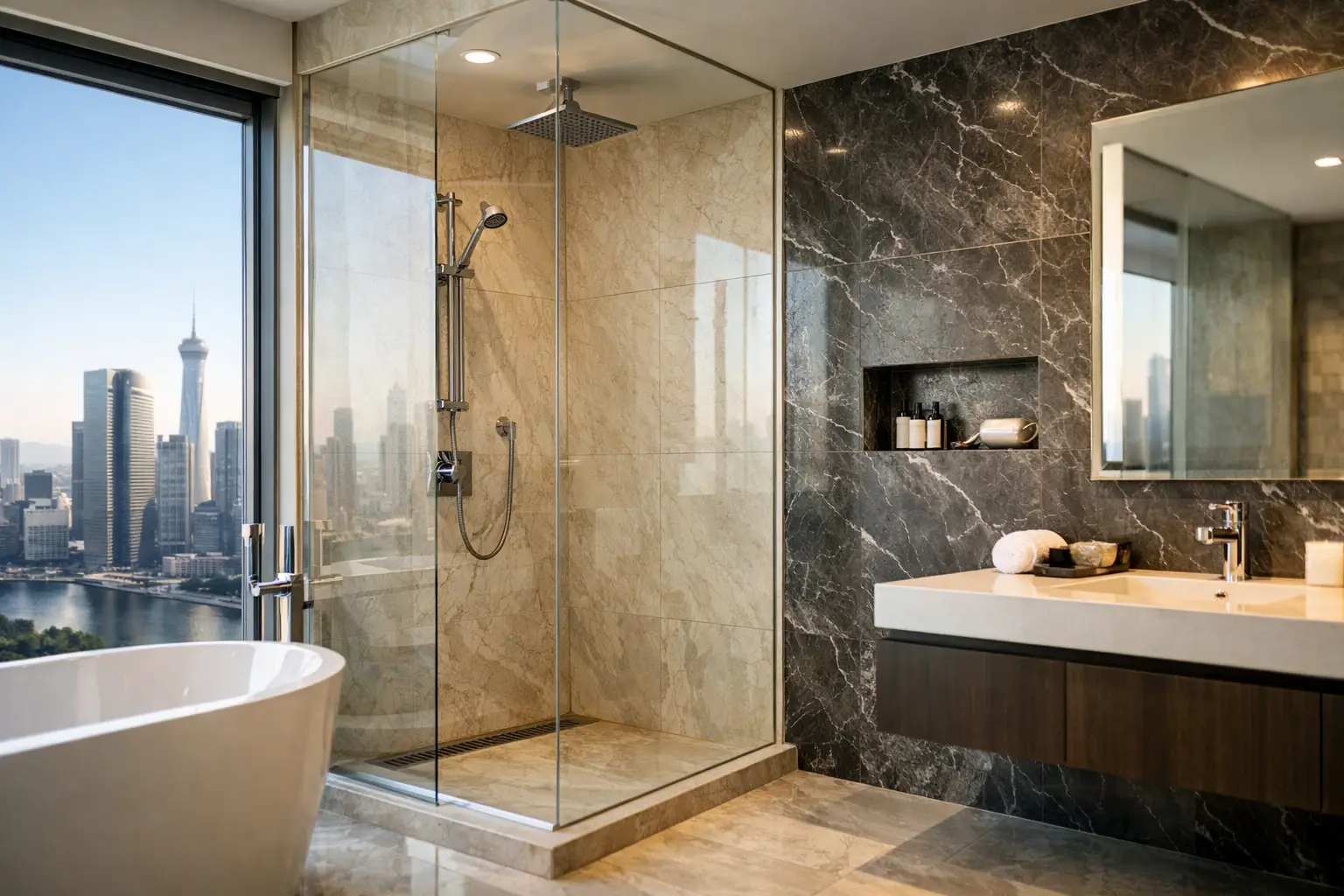
High Rise Bathroom Tiling Case Study
A bathroom on level two and a bathroom on level twenty-two can share the same drawings, tile schedule and finish intent, yet behave very differently once work begins. That is why a high rise bathroom tiling case study is useful for builders, developers and project managers who need more than attractive photos. They need proof that the finish can hold its standard when access is tighter, sequencing is stricter and repetition magnifies every small mistake.
This project involved a multi-unit residential build where bathroom tiling had to be delivered consistently across a vertical site programme. The brief looked straightforward on paper – contemporary porcelain wall tiles, slip-rated floor tiles, recessed niches, clean mitred edges and a restrained, premium palette. The challenge was not the design. The challenge was protecting that design through preparation, waterproofing and installation across a large number of bathrooms without letting pace erode precision.
What this high rise bathroom tiling case study shows
The clearest lesson from this high rise bathroom tiling case study is that bathroom tiling in towers is never just about laying tile neatly. The visible surface is the final expression of many decisions made earlier – substrate tolerances, wet area compliance, material handling, lift access, staging, set-out control and finishing discipline.
On low-density residential work, a minor substrate issue might affect one room. In a high-rise environment, the same issue can repeat across dozens of units if it is not identified and corrected early. That is where experienced trade execution matters. Quality is not created at the point of grout. It is created when someone inspects the walls, checks levels, plans the set-out and refuses to tile over a problem that will show up later.
The project conditions
The bathrooms were designed to feel understated but high-end. Large format wall tiles created a calm visual field, while smaller floor tiles supported falls to wastes and safe wet-area performance. The specification called for sharp alignment through corners, well-positioned cuts around fixtures and a finish that would look consistent from one unit to the next.
What made the job technically demanding was the combination of scale and repetition. Repetition can be efficient, but it can also make defects repeat with equal efficiency. Lift bookings affected material movement. Storage had to be organised tightly. Different trades worked in compressed sequences. Variations in framing and substrate quality appeared between units, even where the plans were identical.
There was also the usual pressure familiar to anyone delivering high-rise work – maintain programme momentum without compromising waterproofing integrity or finish quality. In wet areas, shortcuts are not simply cosmetic risks. They can become defects with expensive consequences.
Starting where quality actually starts
Before a single tile was fixed, every bathroom was assessed for readiness. This included checking the substrate, identifying uneven walls, confirming screed and floor falls, and reviewing penetrations and junctions before waterproofing and tile installation moved ahead. That stage is easy for others to rush because it does not photograph well. It is also the stage that protects the final result.
In several units, minor corrections were needed to bring surfaces back within tolerance. Left unaddressed, those variations would have affected lippage, corner alignment and the visual rhythm of the wall tile layout. On a premium development, those details do not read as small. They read as carelessness.
This is where craftsmanship and project discipline meet. Precision tiling is not about trying to force a perfect finish over imperfect surfaces. It is about making the surfaces fit for a perfect finish first.
Waterproofing and falls were treated as non-negotiable
Bathrooms in high-rise buildings place a premium on risk control. A beautiful tiled finish means very little if moisture management is compromised behind it. Waterproofing was approached as a performance layer, not a procedural box to tick.
Each wet area required careful treatment at corners, junctions, penetrations and shower zones, with particular attention paid to continuity and curing times. Equally important was the relationship between waterproofing and floor preparation. Falls needed to direct water correctly without creating awkward tile cuts or visual distortion.
There is always a trade-off here. Large-format tiles create a refined look on walls, but floors often need formats that work better with drainage geometry. Choosing the right tile for each surface is part of quality-first execution. Forcing one format everywhere may satisfy a design impulse, yet it can make the bathroom perform worse or look unresolved at the waste. The better outcome is usually a balanced one.
Set-out was the difference between ordinary and exceptional
Once surfaces were ready, set-out decisions shaped the success of the project. In bathrooms, clients and purchasers notice symmetry instinctively, even if they cannot explain why one room feels more resolved than another. Tile layout had to account for niches, tapware, shower screens, vanity lines and door thresholds so that cuts landed where they should and the room felt intentional from every angle.
Rather than treating each element in isolation, the installation approach considered the whole room. Feature lines were carried with discipline. Mitred edges were used where the design called for crisp transitions. Niches were positioned and tiled to feel integrated, not inserted as an afterthought.
That matters even more in a multi-unit environment. Consistency is one of the hardest things to achieve at scale because visual drift can creep in over time. If the set-out logic is not fixed early and monitored closely, small differences begin to show from one unit to the next. Premium developments need repeatable excellence, not one or two standout rooms.
Managing scale without losing finish quality
One of the real tests in any high rise bathroom tiling case study is whether quality survives volume. Delivering one excellent bathroom proves skill. Delivering dozens or hundreds with the same standard proves systems, supervision and accountability.
The installation programme was structured around repeatable quality controls. Material batches were checked. Sequencing was coordinated to avoid damage from following trades. Finishing details such as silicone lines, grout consistency and edge cleanliness were treated as part of the craftsmanship, not final-minute tidying.
There is an assumption on some projects that speed and quality sit on opposite sides of the table. In reality, poor organisation is usually what slows a job down. When materials are staged properly, scopes are clear and rooms are genuinely ready, production improves without the finish suffering. Responsiveness on site is part of workmanship. So is knowing when a room should not be tiled yet.
The finish standard clients actually notice
From a distance, many bathrooms can look acceptable. At handover distance, the differences become obvious. The eye catches uneven joints, chipped edges, inconsistent silicone, poorly balanced cuts and floor tiles that fight against the geometry of the room. These are not fussy observations. They are the details that tell a buyer, resident or superintendent whether care was taken.
In this project, the strongest outcome was not any single design flourish. It was the consistency of the finish language across the building. Bathrooms felt calm, clean and resolved. Niches lined up. Corners looked sharp. Transitions made sense. The tiled surfaces supported the architecture instead of distracting from it.
That is the value of disciplined execution. Luxury in wet areas rarely comes from excess. More often, it comes from restraint delivered properly.
What developers and builders can take from this
For project stakeholders, the lesson is straightforward. If a tiling contractor is brought in late, pushed to start before rooms are ready or measured only on square metres per day, the project will almost always pay for it elsewhere. Rework, defects and programme friction cost more than doing the groundwork properly.
The better model is end-to-end accountability – preparation, screeding where required, waterproofing, installation and finishing handled with one clear quality standard. That reduces the gaps where problems usually hide. It also makes communication cleaner, which is essential on vertical builds where timing and access can change quickly.
This is where a specialist contractor adds real value. Not by making big claims, but by controlling the practical variables that protect the outcome. On complex high-rise jobs, that is what keeps quality visible at handover and durable long after occupation.
Perfectly Laid approaches this kind of work with exactly that mindset: precision first, process disciplined, and finish quality protected at every stage.
A well-tiled high-rise bathroom should never feel like a volume product. Even when delivered across many units, it should read as considered, durable and quietly exacting – the kind of work that still looks right when the rest of the project noise has faded.