
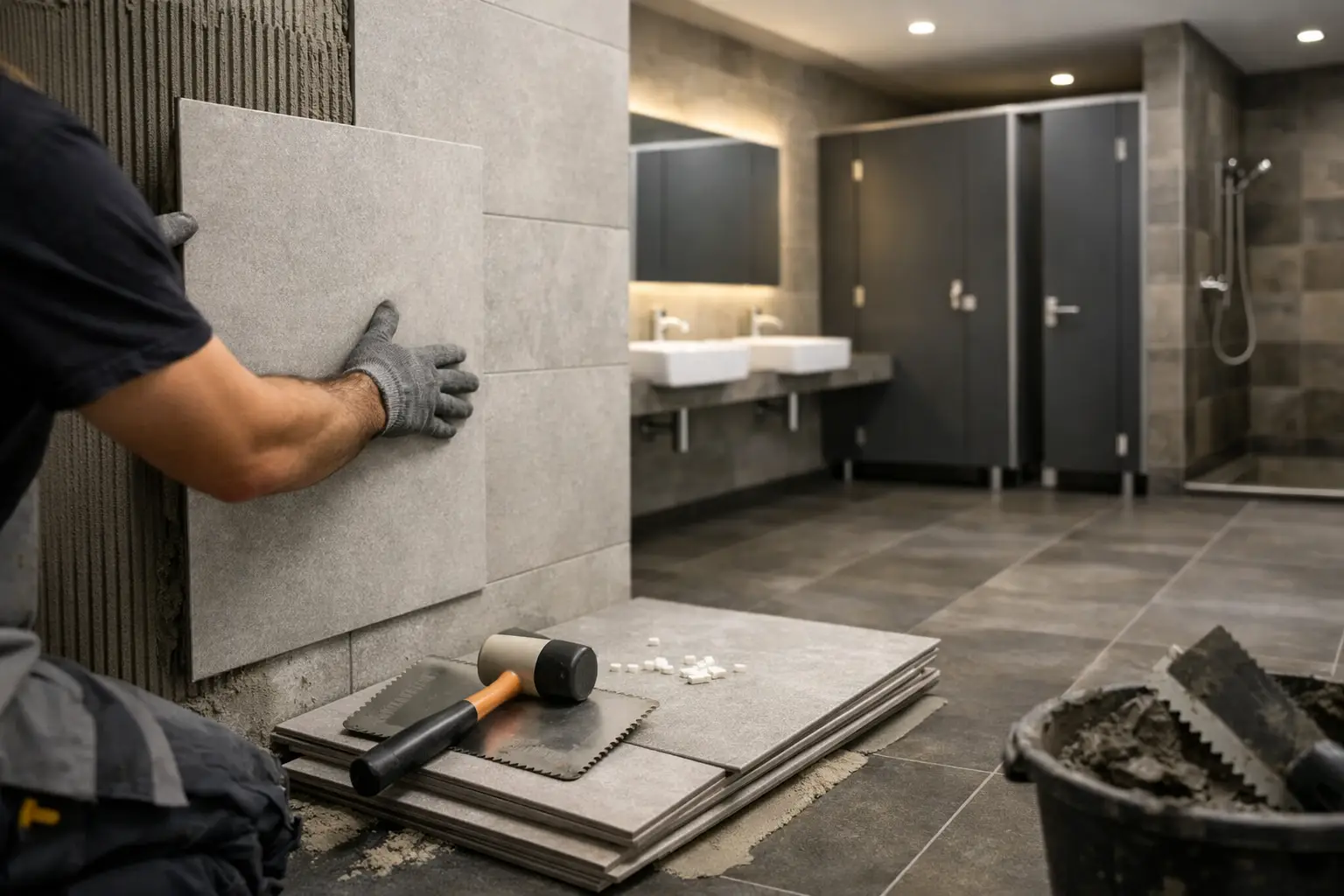
Commercial Bathroom Tiling Guide for Fit-Outs
A commercial bathroom tiling guide should start where most bathroom failures actually begin – not with the tile choice, but with what sits underneath it. In commercial settings, bathrooms work harder, face stricter compliance demands, and are judged more harshly by users. A finish can look refined on handover day and still become a maintenance problem within months if preparation, falls, waterproofing and detailing were treated as secondary.
That is why commercial bathroom tiling is never just a surface decision. For builders, developers, facilities teams and fit-out managers, it is part aesthetics, part performance, and part risk control. The right tiling package protects the programme, supports cleaning and maintenance, and delivers a finish that still looks composed after heavy daily use.
What makes commercial bathroom tiling different
A residential bathroom can often absorb a few small imperfections without immediate consequence. A commercial bathroom rarely gets that luxury. Higher foot traffic, more aggressive cleaning regimes, tighter compliance expectations and a wider range of users all place greater pressure on the installation.
That changes the brief from the outset. Tile selection must account for slip resistance, wear, maintenance demands and visual consistency across larger areas. Substrates must be assessed properly because minor level issues become far more obvious when repeated across multiple cubicles, accessible areas or long wall runs. Detailing also matters more. Mitres, movement joints, floor wastes, threshold transitions and silicone lines all sit in plain view and all affect how the space is judged.
For high-end commercial environments such as hospitality venues, premium retail spaces and boutique developments, there is another layer to consider. The bathroom is often part of the brand experience. If the finish feels careless, the space feels cheap. If the lines are clean, balanced and deliberate, the entire fit-out reads as more resolved.
A commercial bathroom tiling guide to the decisions that matter most
The strongest outcomes usually come from making key decisions early, before demolition is complete and well before tiles are ordered. Many site delays are not caused by the laying itself. They come from late selections, unsuitable substrates, unrealistic set-out expectations or product choices that conflict with the use of the space.
Start with the substrate, not the tile
If the floor is out of level, the walls are not plumb, or previous finishes have left unstable surfaces behind, precision installation becomes harder and more expensive. Screeding, re-levelling and substrate correction are not glamorous line items, but they are often the difference between a premium finish and a compromised one.
On commercial projects, this stage deserves discipline. A tile can only follow the surface it is fixed to. Large-format tiles, in particular, expose unevenness quickly. What looked acceptable under old finishes can become highly visible once new tiles, trim details and lighting are in place.
Waterproofing is part of the system
Bathrooms fail quietly before they fail visibly. Water ingress may not show at the tiled face for some time, but by then the damage can be expensive and disruptive. In commercial work, waterproofing should be treated as an integrated part of the tiling scope, not a box-ticking exercise separated from the realities of site conditions.
The junctions are where discipline shows. Floor-to-wall connections, penetrations, hob details, niches and thresholds need to be handled with care. A clean finish at completion means very little if the system underneath has been rushed.
Falls and drainage need to work in real life
A bathroom floor can meet a drawing and still perform poorly. That usually happens when drainage design and tile layout are not resolved together. Poorly planned falls create ponding, awkward cuts and unhappy users.
This is especially relevant around shower areas, accessible bathrooms and high-use amenities. The floor must direct water efficiently without creating an uncomfortable or visually messy result. Smaller tiles can help around complex falls, while larger formats may suit broader dry areas. It depends on the layout, drain position and finish standard expected.
Choosing tiles for performance and appearance
Not every tile that suits a residential ensuite belongs in a commercial bathroom. The specification needs to respond to traffic, cleaning chemicals, wet area performance and the visual ambition of the project.
Slip resistance is one of the first considerations, particularly on floors exposed to frequent splashing or cleaning. But a higher slip rating is not always a simple win. More textured tiles can improve grip, yet they may also hold more dirt and require more intensive cleaning. In some projects, that trade-off is worth it. In others, especially where appearance and ease of maintenance are both priorities, the better solution is a carefully selected finish used in the right zones.
Tile size also affects the final result. Large-format tiles create a calm, premium look with fewer grout lines, which many commercial clients prefer. They can make compact bathrooms feel more refined and easier to maintain visually. That said, they demand better preparation and more exact set-out. Smaller tiles are more forgiving on uneven substrates and can handle curved or heavily graded areas better, but they create more joints and a busier visual field.
Wall tiles tend to carry the design language of the room. Floor tiles do the harder practical work. The two should complement each other, but they do not need to be identical. A well-resolved commercial bathroom often uses contrast intelligently – quieter, durable flooring paired with wall finishes that elevate the space.
Set-out is where premium work is won or lost
The difference between basic tiling and precision tiling is often set-out. Good set-out makes a room feel intentional. Poor set-out leaves visible compromises at corners, around fixtures and at eye level, even when the material itself is expensive.
In commercial bathrooms, this is particularly important where repetition is involved. If one cubicle has awkward cuts, a whole bank of bathrooms can inherit the same problem. Planning tile lines against vanities, partitions, mirrors, tapware and wastes helps avoid that domino effect.
This is also where experience protects the client’s outcome. A contractor who thinks beyond square metres and into sightlines, transitions and finish sequencing will usually save time and reduce rework later. Perfectly Laid approaches these details as part of the craft, because the cleanest result is almost always the result that was planned properly from the beginning.
Managing programme pressure without sacrificing finish
Commercial bathrooms are often delivered under compressed programmes. Fit-out schedules are tight, trades overlap, and access windows can shift with little notice. Speed matters, but speed without control usually shows up in the details.
The practical answer is not to cut corners. It is to manage sequencing tightly. Demolition, surface preparation, waterproofing, curing times, tile installation, grouting and caulking all need enough room in the programme to be done correctly. When one stage is rushed, the next stage pays for it.
For builders and project managers, this is where responsive communication matters as much as workmanship. If substrate issues, delayed fixtures or drawing conflicts are identified early, the tiling package can often stay on track. If they are ignored until installation day, the programme tightens and the finish suffers.
Common mistakes that cost more later
Many commercial bathroom issues are predictable. Tiles selected on appearance alone can become slippery or difficult to maintain. Inadequate falls lead to standing water. Inconsistent silicone work makes a new bathroom feel unfinished. Poor movement allowance can contribute to cracking over time.
Another common mistake is underestimating finishing details. Caulking, edge trims, mitred corners, grout choice and alignment around fixtures are sometimes treated as cosmetic extras. They are not. These are the details that shape first impressions and long-term serviceability.
There is also the temptation to value-engineer the visible finish while overlooking the preparation beneath it. That can create a false economy. Saving modestly at the substrate or waterproofing stage can lead to rectification costs that far exceed the original allowance.
What clients should expect from a tiling partner
A strong commercial tiling contractor should offer more than labour. They should understand the entire tiled assembly, identify risks early and execute with consistency across every room or unit. That includes preparation, levelling, waterproofing, installation and finishing, all carried out with a clear standard rather than improvised trade-by-trade.
For developers and builders handling multi-unit or high-rise delivery, consistency becomes just as important as quality in any one bathroom. A beautiful sample room means little if standards drift across the rest of the project. Reliable execution is not flashy, but it is what protects timelines, defects periods and client confidence.
The best commercial bathrooms do not call attention to trade problems. They simply feel solid, composed and easy to use. That result comes from decisions made early, details executed properly and a contractor who treats tiling as both a technical system and a visual craft.
If you are planning a commercial bathroom, the smartest move is to judge the tiling package by what happens before the first tile is laid – because that is usually where the lasting quality is decided.