9 Best Tile Patterns for Small Bathrooms
A small bathroom can feel sharp and refined, or cramped and visually busy. The difference often comes down to layout decisions that look minor on a sample board but change everything once the room is tiled. Choosing the best tile patterns for small bathrooms is less about chasing trends and more about controlling scale, direction and visual flow.
Pattern affects how the eye reads the room. It can make a narrow bathroom appear wider, a low ceiling feel taller, or an awkward shower recess sit more comfortably within the overall design. Get it right and the space feels considered. Get it wrong and even premium tiles can look unsettled.
What makes a tile pattern work in a small bathroom?
In compact spaces, every line matters. Grout joints, tile edges and directional layouts all create movement, and that movement either opens the room up or cuts it into smaller visual sections. The best results come from patterns that simplify the read of the room rather than overcomplicate it.
That does not always mean plain or predictable. A small bathroom can absolutely handle character. The key is restraint in the right places. If the floor pattern is doing heavy visual lifting, the wall layout may need to stay calm. If the room has multiple corners, nib walls or recessed niches, a straightforward set-out often looks more expensive than an intricate pattern forced into tight dimensions.
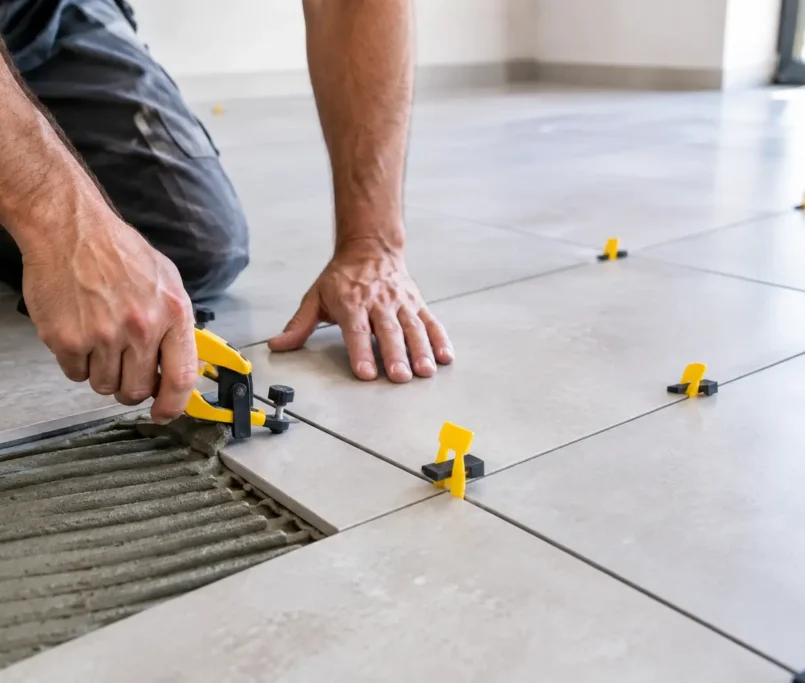
Preparation matters too. A pattern only looks precise when the substrate is properly levelled, waterproofed and set out with discipline. In small bathrooms, slight irregularities are easier to spot because there is nowhere for them to hide.
Best tile patterns for small bathrooms
1. Straight lay for a clean, spacious look
A straight lay pattern remains one of the strongest choices for small bathrooms because it creates order. Tiles are stacked in even rows, vertically and horizontally, which gives the room a quiet, architectural feel. This works especially well with rectified porcelain tiles and fine grout lines, where the finish reads crisp rather than fussy.
On floors, straight lay suits bathrooms where you want the eye to move easily from the doorway to the back wall. On walls, it pairs well with larger format tiles because it reduces grout interruption. The trade-off is that a straight lay pattern shows poor set-out quickly. If cuts are inconsistent or centring is off, the simplicity of the pattern will expose it.
2. Vertical stack to lift the ceiling
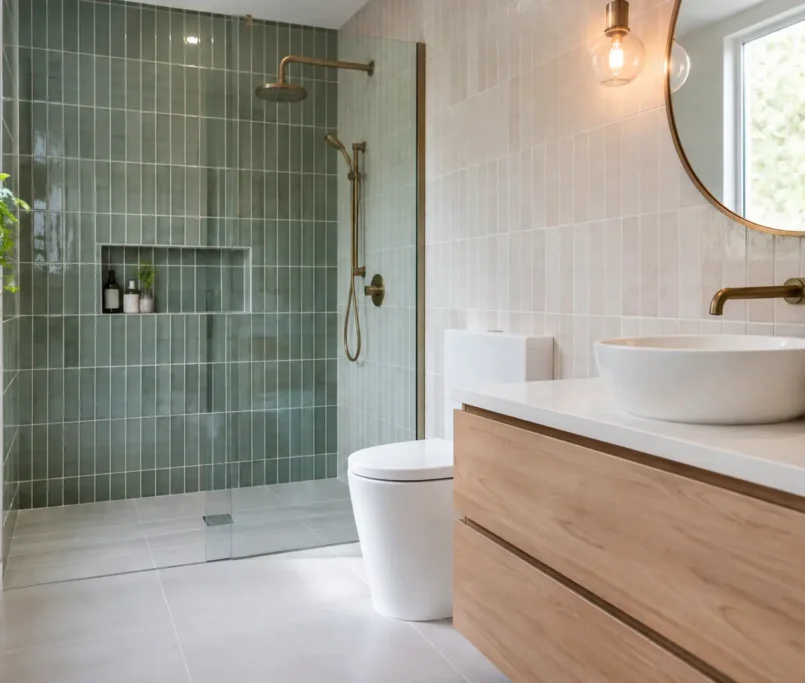
If the bathroom feels low or compressed, a vertical stack pattern can help. Tall rectangular tiles laid upright draw the eye upwards, which gives the impression of more height. In shower walls, this can be particularly effective when the tiles run floor to ceiling without a break.
This pattern works best when the room already has a clean, modern direction. It is less forgiving in older bathrooms with uneven walls unless preparation has been handled properly. The appeal is in its precision, so alignment and finishing need to be exact.
3. Horizontal stack to widen a narrow room
For bathrooms that are tight from side to side, a horizontal stack layout can visually stretch the space. Rectangular tiles laid lengthways encourage the eye to travel across the room, which can soften that corridor-like feel common in ensuites and compact family bathrooms.
There is a balance to strike here. Used on every surface, horizontal emphasis can make a ceiling feel lower. Often the strongest solution is to use the layout selectively, perhaps on the main wall plane, while keeping the floor or adjoining walls more understated.
4. Brick bond for softer movement
Brick bond, sometimes called running bond, offsets each row so the joints do not align. It introduces movement without becoming dominant, which makes it a reliable option for small bathrooms that need a little warmth or softness. Subway tiles in brick bond are a classic example, but the pattern also works with larger formats when kept controlled.
The reason it suits smaller rooms is that it breaks up rigid lines while still feeling familiar and organised. The caution is proportion. With long rectangular tiles, a half-offset can sometimes highlight lippage if the tile has any bow. A one-third offset is often the cleaner technical choice.
5. Herringbone for detail in the right place
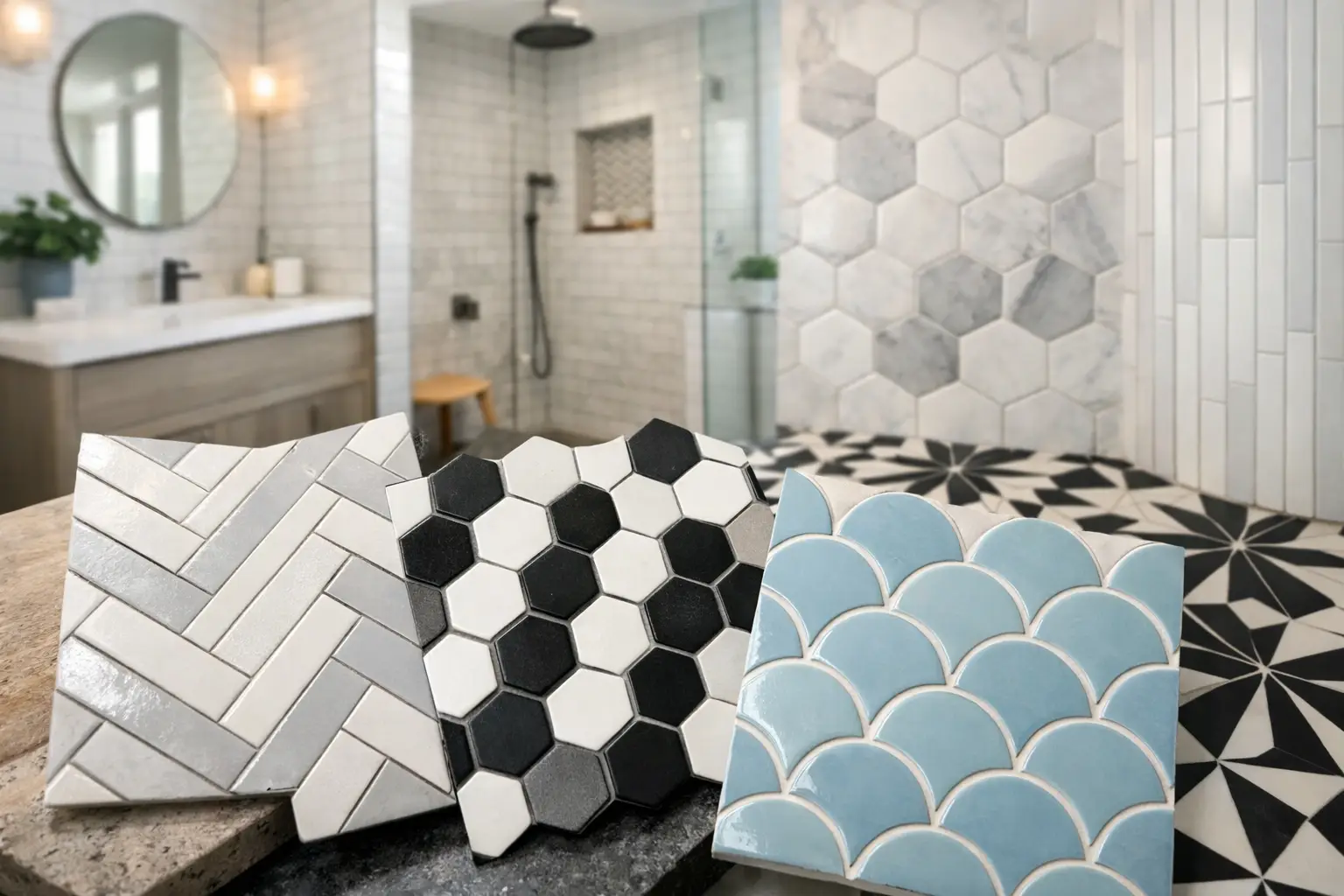
Herringbone can look exceptional in a small bathroom, but placement matters. Because the pattern is active, it tends to work best as a feature rather than across every surface. A shower wall, vanity splashback or floor inset can carry herringbone beautifully without overwhelming the room.
Used well, it adds craftsmanship and a bespoke feel. Used everywhere, it can make a compact bathroom feel visually crowded. This is one of those patterns where material choice matters just as much as layout. A tonal tile with subtle variation usually feels more refined than a busy stone-look surface paired with a complex pattern.
6. Large format layout for fewer grout lines
Strictly speaking, large format is more about tile size than pattern, but the layout approach is central to how a small bathroom reads. Large format tiles laid in a simple grid can make a compact room feel calmer because there are fewer grout joints breaking up the surfaces.
This is often one of the smartest answers for contemporary bathrooms where the goal is understated luxury. It also helps walls and floors feel more monolithic. The catch is installation quality. In small bathrooms, floor falls, waste positions and wall variations need careful management so the finished tilework still looks balanced and intentional.
7. Diagonal lay to change the room’s geometry
A diagonal pattern sets square tiles at a 45-degree angle. It can be very effective in small bathrooms because it shifts attention away from the room’s actual dimensions. Rather than seeing the width and length immediately, the eye follows the diagonal movement, which can make the space feel less boxy.
This pattern is useful in older homes where the room shape is not perfectly square. It adds energy, but it also creates more cuts at the perimeter, so execution has to be neat. If the bathroom already contains several visual elements such as niches, feature strips or contrasting fixtures, diagonal may be too much.
8. Kit kat or finger mosaic in vertical lines
Slim mosaic formats such as kit kat tiles are often chosen for texture, but their pattern can do more than add interest. Installed vertically, they can make a small shower wall feel taller and more elegant. They also suit curved surfaces, tight returns and niches where larger tiles would require awkward cuts.
Because these tiles create many grout lines, they need careful colour selection. Matching grout keeps the surface more cohesive, while high-contrast grout will emphasise every joint and can make the space feel busier. In a small bathroom, cohesion usually wins.
9. Floor-to-wall continuation for visual flow
One of the most effective small-bathroom strategies is not a classic pattern name at all. It is the decision to continue the same tile, or at least the same directional layout, from floor to wall. That continuity reduces visual stops and makes the room feel more resolved.
This approach works especially well in walk-in showers where there is minimal interruption between zones. It creates a premium, tailored look and can make the footprint appear larger than it is. The success of this method depends on disciplined set-out, especially around corners and transitions.
How to choose the right pattern for your bathroom
The best pattern depends on what the room needs correcting. If the ceiling feels low, look at vertical emphasis. If the room is narrow, think about horizontal movement. If the space already has strong fixtures or stone veining, a quieter pattern may let those elements lead.
Tile size also changes the result. A herringbone in a tiny mosaic reads very differently from herringbone in an elongated porcelain tile. Likewise, a straight lay with oversized tiles can feel expansive, while the same pattern in a small format can feel more traditional and detailed.
Lighting matters more than many clients expect. Natural light tends to flatter texture and variation, while darker bathrooms often benefit from simpler layouts that do not rely on shadow lines to make sense. Finish matters too. Gloss tiles can bounce light around a compact room, but they also highlight alignment issues if the installation is not exact.
Design choices that strengthen the pattern
Grout colour has a major influence on whether a pattern feels calm or pronounced. Close-matched grout creates a more continuous surface, which is usually helpful in small bathrooms. Contrast grout can be striking, though it tends to make the grid more obvious and can shrink the room visually if overused.
Tile orientation should also respond to the room rather than the showroom display. A pattern that looks impressive on a board may not suit a bathroom with multiple internal corners, boxed pipework or a tight shower return. This is where experienced set-out becomes valuable. The pattern needs to be designed for the actual space, not just selected in principle.
And while style matters, performance cannot be treated as secondary. Floor tiles must suit wet-area slip requirements, and complex patterns should never compromise proper falls, waterproofing integrity or clean finishing around wastes and fixtures. Premium bathrooms feel effortless because the technical work has been handled properly beneath the surface.
A small bathroom does not need more decoration. It needs better decisions. The right tile pattern gives the room clarity, proportion and polish, turning limited square metres into a space that feels composed from the first glance to the final detail.