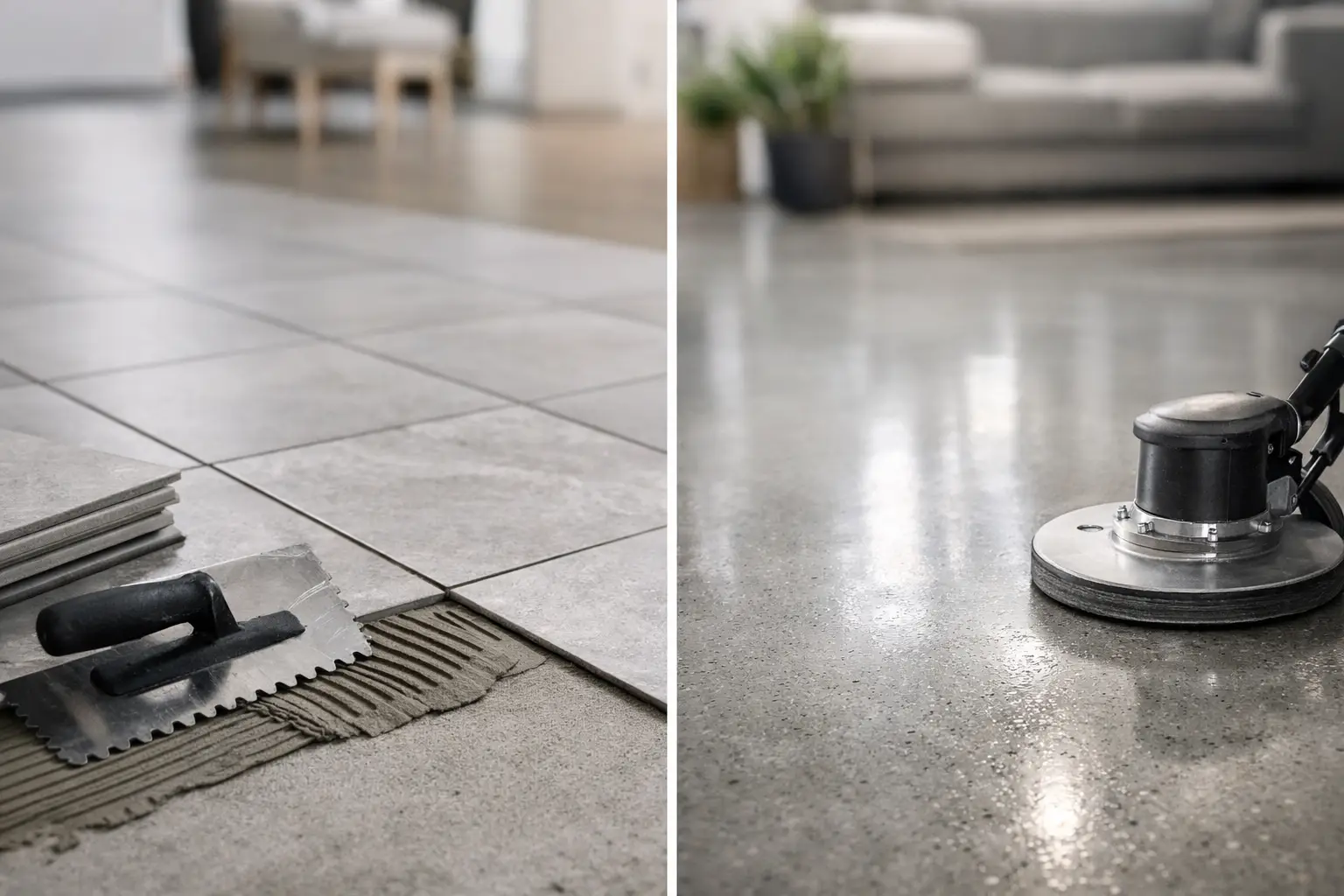
Floor Tiling vs Polished Concrete
A floor finish rarely looks costly on a mood board. The real test comes later – under chairs dragged daily across a dining area, in wet bathroom corners, at retail entries collecting grit, or across multi-unit projects where consistency matters just as much as appearance. That is where floor tiling vs polished concrete becomes a serious specification decision rather than a styling preference.
Both finishes can look refined. Both can perform exceptionally well when executed properly. But they behave very differently once you factor in substrate condition, moisture exposure, movement, maintenance expectations and the standard of finish required. If the brief is premium, durable and built to last, the right choice depends less on trends and more on where the floor sits, how it will be used and how precisely it will be installed.
Floor tiling vs polished concrete: what really separates them
The biggest difference is control. Tiling is a constructed finish made from individual units laid over a prepared substrate, which means the final result can be highly tailored in format, slip rating, pattern, tone and detailing. Polished concrete is more dependent on the slab itself. Its beauty comes from refining what is already there, not covering it.
That distinction matters. With tile, a skilled installer can correct levels, manage falls, waterproof wet areas, introduce movement joints and create a deliberate visual outcome. With polished concrete, the slab tells part of the story. Aggregate exposure, cracking, patching and colour variation can all shape the final appearance, sometimes beautifully, sometimes less predictably.
For clients who want a crafted, tightly controlled finish, floor tiling usually offers more precision. For clients drawn to a monolithic industrial look and comfortable with a degree of natural variation, polished concrete can be compelling.
Design flexibility and finish quality
Floor tiling has a much broader design range. Porcelain, natural stone and feature formats open up options that polished concrete simply cannot match. Large-format tiles can create calm, architectural spaces. Stone-look porcelain can bring warmth without the maintenance burden of natural material. Textured external tiles can carry the design language from inside to alfresco areas with the right slip resistance.
This is especially useful in high-end residential work and design-led commercial fit-outs, where the floor needs to support joinery, lighting and fixtures rather than just sit beneath them. Tile gives you sharper control over tone, grout colour, layout and transitions between spaces. In boutique developments or repeated flat layouts, it also allows greater consistency from one unit to the next.
Polished concrete is more singular in character. It suits minimalist interiors, hospitality venues, galleries, some retail settings and contemporary homes where a raw, understated finish is part of the concept. When done well, it has depth and a clean visual continuity that many clients love. But there is less room to steer the final look once grinding begins. If the slab has imperfections, they often remain part of the finished floor.
Durability is not one simple question
Both surfaces are durable, but they fail differently.
A well-installed porcelain tile floor is extremely hard-wearing and resistant to everyday wear, staining and moisture. If a tile is damaged, individual sections can sometimes be replaced without redoing the whole floor, provided matching stock is available. Performance depends heavily on correct preparation, adhesive selection, movement allowance and finishing. Poor installation is usually the weak point, not the tile itself.
Polished concrete is also durable, particularly in large open areas with steady foot traffic. It does not have grout lines and can cope well with commercial use. However, concrete can crack, and those cracks may become part of the floor’s appearance. Some clients accept that as character. Others see it as a defect. Heavy impact can also chip edges or leave visible damage, and repairs are not always invisible.
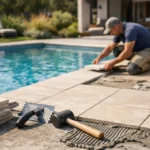
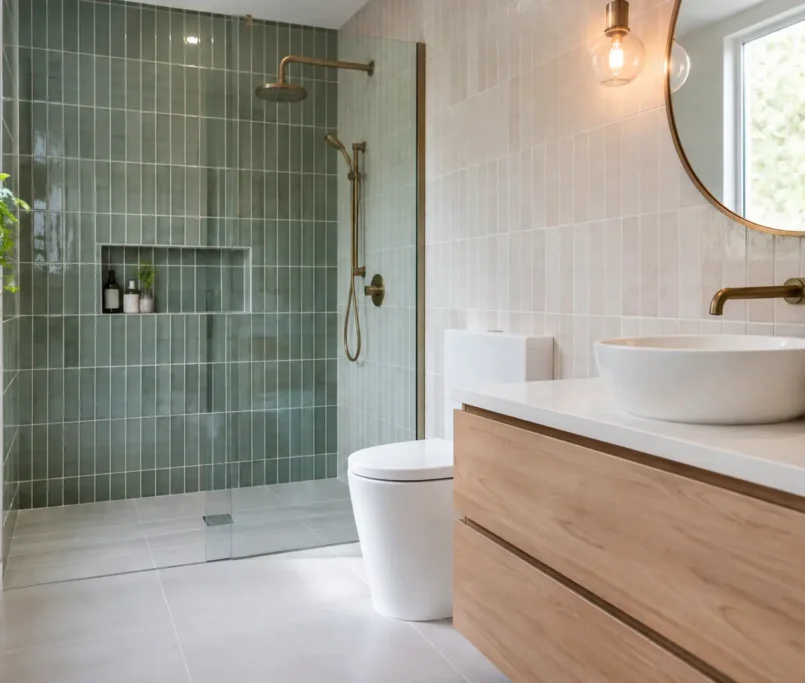
In wet environments, the answer becomes clearer. Bathrooms, laundries, pool surrounds and many external spaces favour tile because the system can be built for water management and slip safety. Concrete is not the first choice where falls to wastes, waterproofing integration and wet-grip performance are critical.
Preparation decides everything
This is where many comparisons become misleading. The visible finish gets the attention, but the substrate determines whether the result lasts.
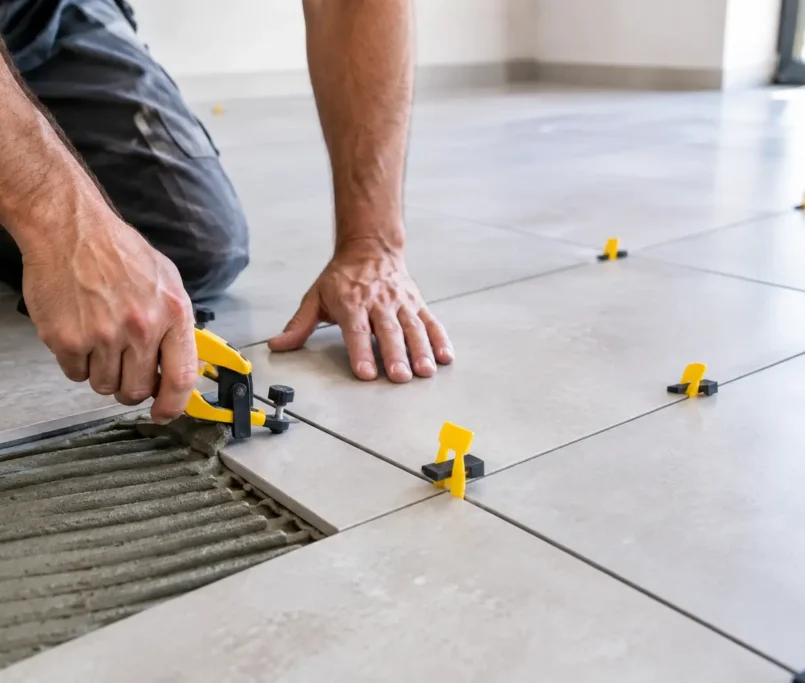
Tiling allows a floor to be engineered into shape. Uneven surfaces can be corrected. Falls can be formed. Waterproofing can be integrated where required. Screeding and levelling make it possible to deliver a precise finished plane even when the base is far from perfect. On complex renovations or commercial refurbishments, that level of control protects the outcome.
Polished concrete can be simpler if the slab is already structurally sound, level enough and visually suitable for polishing. If it is not, costs rise quickly. Existing coatings may need to be removed. Cracks and patches can become more obvious after grinding. In some projects, clients choose polished concrete expecting simplicity, only to discover that the existing slab is not presentation-grade.
That is why the best decision often comes after site inspection, not before. A premium finish starts with honest assessment. If the slab is poor, polishing may expose problems rather than solve them.
Cost: initial spend versus whole-life value
There is no universal winner on price because the variables are different.
Floor tiling can range widely depending on tile selection, format, laying pattern, substrate work and detailing. A straightforward tile in a regular format is one thing. A large-format porcelain with intricate cuts, premium trims, waterproofing and extensive preparation is another. Yet that cost often buys clarity: you know the finish you are specifying, and you know what is needed to achieve it.
Polished concrete is sometimes perceived as the cheaper option because the slab already exists. That can be true on the right project. On the wrong slab, polishing, densifying, crack treatment and repair work can close the gap quickly. If visual consistency is essential, those variables matter.
For developers and project managers, cost should be weighed against repeatability and defect risk. Tiling is often easier to standardise across multiple units or fit-outs because materials and installation methods are more controllable. That reliability has value, especially when programme pressure is high.
Maintenance and day-to-day living
Porcelain tile is generally straightforward to maintain. It handles spills well, suits busy households and performs strongly in hospitality and retail settings. Grout lines do require attention, especially if the specification or installation quality is poor, but high-quality materials and proper finishing make a considerable difference.
Polished concrete is also relatively low-maintenance, though it is not maintenance-free. It may need resealing or periodic treatment depending on traffic and exposure. It can show dust, marks and fine scratching in certain light. In homes, it can feel hard and cooler underfoot, which some clients appreciate and others do not.
That comfort question is worth taking seriously. In a family kitchen-living area, tile offers more options to soften the feel visually and practically, particularly when paired with underfloor heating or selected in warmer tones. Polished concrete tends to hold a more austere, architectural presence.
Where each option tends to work best
Tile is the stronger all-rounder for bathrooms, laundries, kitchens, alfresco areas, pool surrounds and commercial spaces where slip resistance, water management and finish control matter. It is also ideal where the brief is distinctly premium and the design language needs detail, texture and cohesion across different zones.
Polished concrete works best in open-plan interiors, selected retail spaces, hospitality venues and some contemporary homes where the slab quality is good and the design intent genuinely suits a monolithic look. It can be striking, but it is less forgiving of substrate flaws and less adaptable in wet or highly detailed areas.
For many projects, the smartest answer is not either-or. Tiling and polished concrete can sit within the same scheme, each used where it performs best. Concrete may suit the main living zone, while tile carries through bathrooms, service areas and outdoor spaces. The strongest outcomes come from matching the finish to the function rather than forcing one material everywhere.
Choosing with confidence
If your priority is design flexibility, controlled detailing, strong wet-area performance and a finish that can be tailored to the space, floor tiling is often the more dependable investment. If your priority is a pared-back industrial aesthetic and the existing slab is good enough to justify polishing, concrete may be the right call.
The key is not choosing the finish that photographs best in isolation. It is choosing the one that will still look considered after years of foot traffic, cleaning, movement and daily use. That is why precise preparation, disciplined installation and a clear understanding of the site matter so much. Beautiful floors are never accidental. They are built that way, from the ground up.
If you are weighing both options, start with the realities of your project – the substrate, the use of the space, the moisture exposure and the standard of finish expected. The right floor should do more than complete the room. It should quietly protect the quality of everything built around it.