Tiling Over Existing Tiles: Pros and Cons
If you are weighing up tiling over existing tiles pros and cons, the real question is not whether it can be done, but whether it should be done in your particular space. Overlay tiling can save time, reduce mess and keep a renovation moving. It can also lock hidden problems beneath a new finish if the substrate is not properly assessed first.
That distinction matters in bathrooms, kitchens, laundries and commercial spaces where performance is just as important as appearance. A premium tiled finish only looks effortless when the preparation behind it is disciplined, precise and suited to the room.
Tiling over existing tiles pros and cons at a glance
Overlaying new tiles onto old ones is sometimes an excellent solution. In the right setting, it avoids unnecessary demolition, shortens programme time and reduces disposal costs. For occupied homes or active commercial sites, less dust and less disruption can be a major advantage.
But this method is not a shortcut to quality. It only works when the existing tiled surface is sound, well bonded, level enough to receive a new finish and appropriate for the added build-up. If the original installation is compromised, the new layer simply inherits those weaknesses.
In other words, tiling over tiles is a judgement call. Good workmanship starts with honest assessment, not automatic convenience.
The main advantages of tiling over old tiles
The most obvious benefit is speed. Removing old wall or floor tiles can be labour-intensive, noisy and unpredictable. Once demolition starts, you may uncover damaged substrates, poor waterproofing, crumbling screeds or uneven backgrounds that require more repair than expected. Overlay tiling can avoid that chain reaction when the existing base is stable.
There is also a cleaner renovation experience. For homeowners, that can mean less disruption to daily life and less fine dust moving through the property. For builders and project managers, it can support tighter sequencing and reduce pressure on adjoining trades.
Cost can improve too, although not always as dramatically as people assume. You may save on demolition labour, skip some waste removal and shorten the overall installation period. In projects where access is difficult or where minimising downtime matters, those savings become more meaningful.
From a design perspective, tiling over an existing finish can also be practical when a space needs a visual reset rather than a structural rebuild. An outdated bathroom or kitchen can be transformed with a more refined format, texture or palette without stripping everything back to bare substrate.
Where the drawbacks start to matter
The biggest risk is simple: old problems do not disappear because they are covered. Hollow tiles, movement, moisture issues, poor adhesion or a failing waterproofing system underneath can all compromise the new installation.
Height build-up is another common issue. A second tile layer raises floor levels and changes transitions into adjoining rooms. It can affect skirtings, door clearances, cabinetry, shower thresholds and drainage falls. On walls, extra thickness can interfere with trims, fittings and a clean junction at windows or architraves.
Weight also deserves attention. In many domestic applications the additional load is manageable, but not every wall or substrate should be treated casually. This is especially relevant on large-format wall tiles, older backgrounds or commercial projects where compliance and durability are under greater scrutiny.
Then there is the question of finish quality. Even a beautiful tile will not sit beautifully over an uneven, poorly prepared base. Lippage, inconsistent lines and compromised edges often begin with the assumption that overlay tiling is faster because preparation can be lighter. In reality, precision still depends on careful surface correction and methodical installation.
When tiling over existing tiles is a sensible option
Overlay tiling tends to work best when the current tiles are firmly bonded, largely level, free from significant cracking and not affected by moisture-related failure. The room should also allow for the extra thickness without creating awkward thresholds or functional problems.
A straightforward splashback is often a stronger candidate than a shower floor. Likewise, a dry internal wall may present fewer risks than a wet area where waterproofing integrity is critical. In some bathroom refurbishments, wall tiling over an existing surface can be viable, while the floor or shower area may call for more invasive work.
For commercial fit-outs, the decision often comes down to programme, substrate condition and performance requirements. If a site needs a fast aesthetic upgrade with minimal disruption, overlay tiling may support that brief. If the area is high-wear, moisture-prone or already showing signs of movement, full removal is usually the safer path.
When removal is the better investment
If tiles sound hollow, lift at the edges or show widespread cracking, they are not a reliable foundation. The same applies where the substrate beneath has deflected, where falls are wrong, or where there is evidence of water ingress.
Bathrooms deserve particular caution. If there is any doubt about the condition of the waterproofing, simply tiling over the top may create a polished finish with a short life. A high-end bathroom should not depend on guesswork beneath the surface.
Removal is also often the right choice when proportions and detailing matter. In premium residential and design-led commercial spaces, small compromises can be visually obvious. Bulky reveals, clumsy transitions and uneven floor heights tend to undermine the final result, no matter how beautiful the tile selection is.
Sometimes the smartest way to protect the finished look is to go backwards before moving forwards.
Preparation decides the outcome
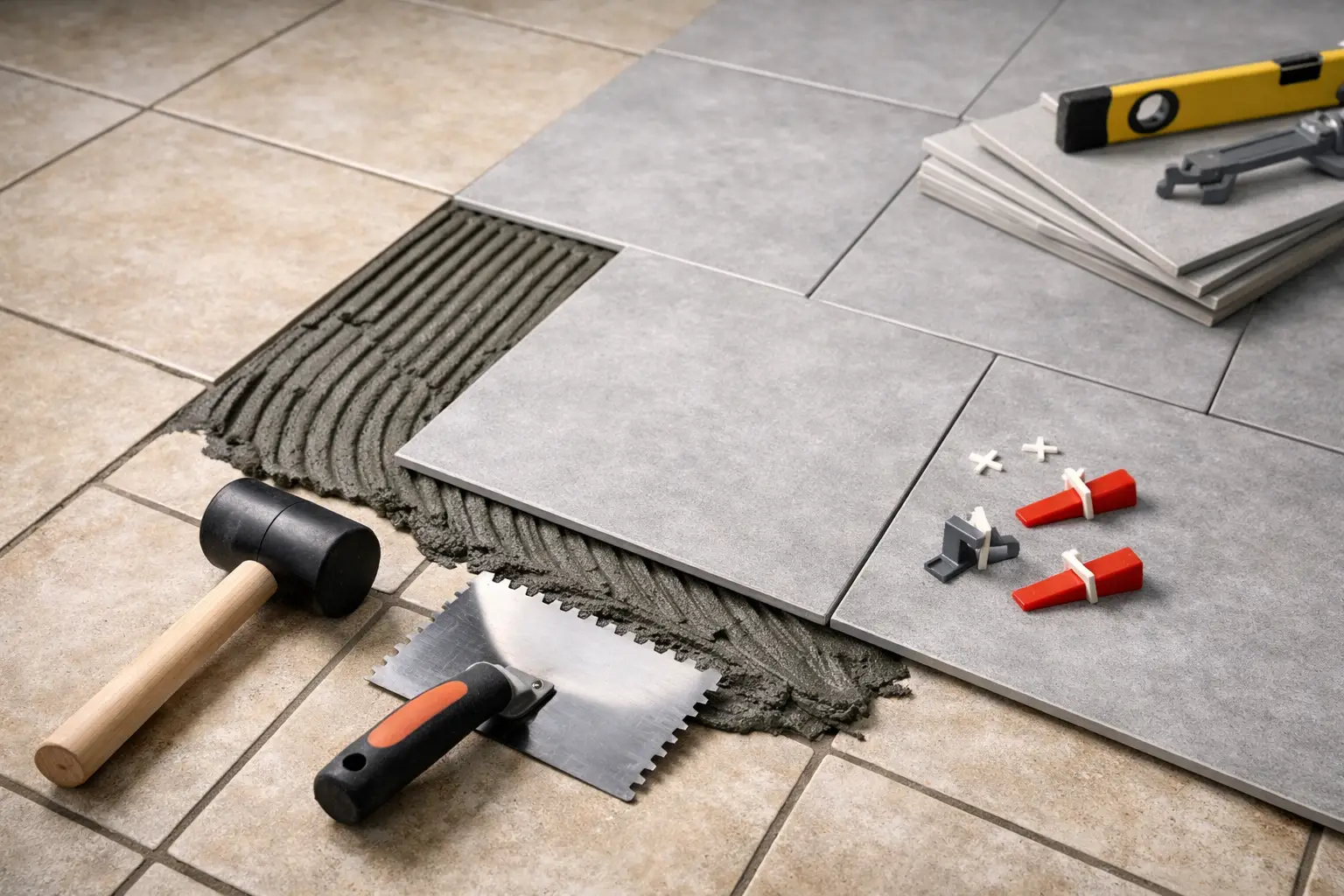
If an overlay installation is approved, the preparation stage becomes non-negotiable. Existing tiles must be checked for bond, cleaned thoroughly and stripped of contaminants such as soap residue, grease, polish or sealers that could interfere with adhesion.
Mechanical abrasion or other suitable surface preparation is usually required to create a proper key. Any failed tiles must be removed and repaired. Levels need to be checked carefully, because adhesive is not a magic fix for poor geometry. On floors, falls and drainage still have to function correctly after the new layer is installed.
Adhesive selection matters as well. The bond system needs to suit both the existing substrate and the new tile specification. That becomes even more important with porcelain, large-format products and wet areas. Precision installation is not just about getting tiles straight – it is about building a finish that remains stable, crisp and serviceable over time.
Wet areas need a stricter lens
This is where many overlay conversations become more serious. In showers, bathrooms and laundries, aesthetics cannot be separated from water management. If the existing tiled assembly is compromised, a new finish on top does not restore waterproofing where it has already failed.
There are situations where partial overlay solutions are workable, but they require a disciplined assessment of membranes, junctions, penetrations and drainage. If that level of certainty is not available, removal and reinstatement is usually the more responsible recommendation.
Clients sometimes hope overlay tiling will deliver a luxury bathroom with less cost and less downtime. Sometimes it can. But when moisture risk is part of the picture, protecting the long-term outcome should carry more weight than shaving a few days off the programme.
Aesthetic finish versus hidden compromise
The appeal of tiling over old tiles is easy to understand. It promises visible transformation with less upheaval. Yet in premium spaces, the finish is judged by more than the tile face. It is judged by alignment, transitions, edge detailing, plane consistency and the confidence that the installation has been executed properly beneath the surface.
That is why experienced tilers do not give a blanket yes or no. They inspect, test, measure and question. The objective is not to preserve old work at any cost. It is to choose the method that protects durability, visual sharpness and the overall integrity of the project.
For some homes and fit-outs, overlay tiling is a practical, efficient choice. For others, it is a false economy dressed up as convenience.
Perfectly Laid approaches that decision the same way it approaches every installation – with a focus on preparation, precision and a finish that deserves to last.
Before you commit to tiling over an existing surface, make sure you are not only asking how quickly the room can be refreshed, but whether the result will still look and perform exactly as it should years after the grout has cured.