How to Waterproof a Tiled Balcony Properly
A tiled balcony can look sharp on handover and still fail within a season if the waterproofing beneath it is wrong. The visible finish often gets the attention, but when clients ask how to waterproof a tiled balcony, the real answer starts well before the first tile is laid. What protects the space is not the tile itself. It is the system underneath – substrate, falls, membrane, detailing and movement control – all executed with precision.
Why balcony waterproofing fails so often
Balconies are unforgiving. They deal with standing water, temperature swings, direct sun, wind-driven rain and constant expansion and contraction. Add foot traffic and rigid finishes like porcelain or stone, and any weakness in the build-up is exposed quickly.
In most failures, the tile is blamed first because that is what people can see. In reality, the tile layer is only one part of the assembly. Water usually gets in through poor falls, weak junction detailing, cracked grout, failed sealant, blocked drainage or a membrane that was never suitable for external use in the first place. Even a premium tile finish cannot compensate for a balcony that has been built without proper preparation.
This is why waterproofing a tiled balcony is never a single-product decision. It is a sequencing decision. Every layer has to support the one above it.
How to waterproof a tiled balcony from the substrate up
If you want a balcony that looks refined and performs properly over time, start with the structure. The substrate must be sound, stable and suitable for external tiling. Concrete is common, but not all concrete slabs are ready to receive waterproofing. Cracks, laitance, contamination, poor curing and inconsistent falls all need to be addressed first.
The next critical factor is drainage. A balcony should shed water efficiently, not invite it to sit on the surface and test every joint for weakness. That means creating correct falls to waste before waterproofing begins, not trying to hide poor levels with adhesive during tiling. Adhesive is for bonding tile, not correcting substrate defects.
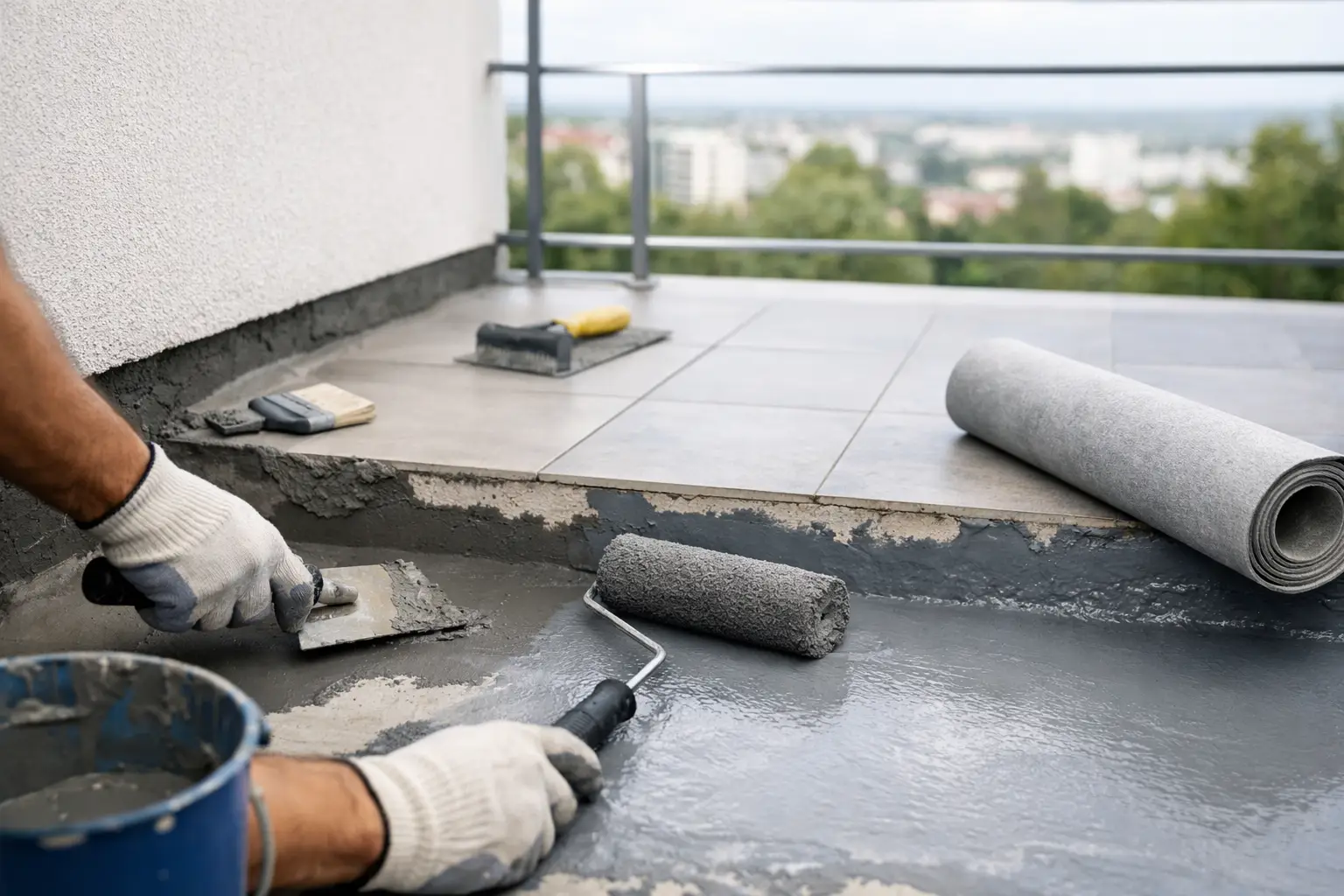
Once the substrate is properly prepared and the falls are confirmed, the membrane system can be installed. For external tiled balconies, the membrane must be suited to UV exposure where relevant, compatible with the substrate, and capable of handling movement. More importantly, it must be applied to the correct thickness and with disciplined detailing at all transitions.
Corners, wall-floor junctions, balustrade penetrations, door thresholds and outlets are where good systems either hold or fail. Reinforcing bandage, bond breakers and compatible sealants are not optional extras. They are what allow the membrane to move without splitting at stress points.
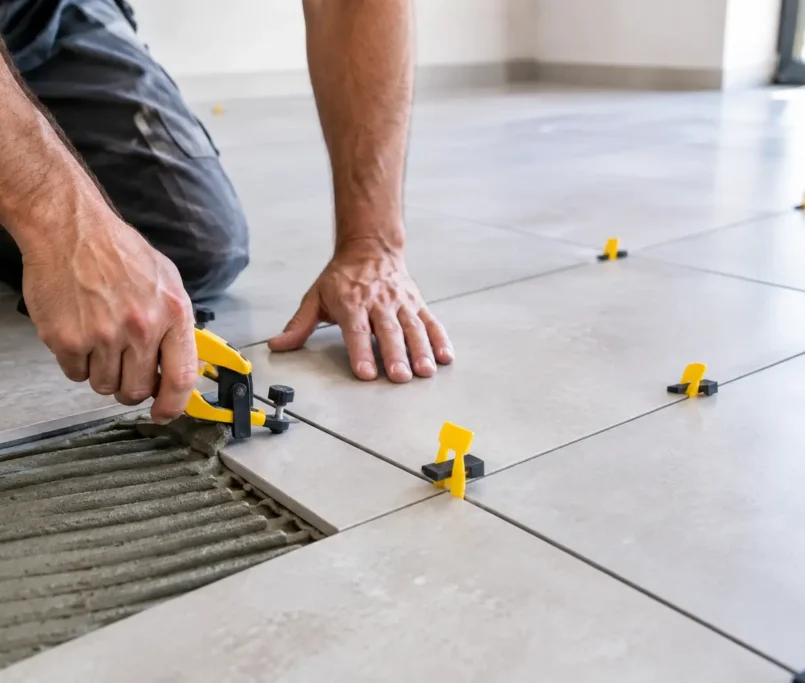
After the membrane cures, protection and tile installation matter just as much. The wrong adhesive, rushed curing, poorly planned joints or hard-set perimeters can compromise the whole assembly. Waterproofing is not complete when the membrane dries. It is complete when the tiled finish above it respects the movement and drainage designed into the system.
Falls are not a finishing detail
One of the most common balcony defects is inadequate fall. If water ponds after rain, the balcony is already underperforming. Ponding increases staining, encourages efflorescence, puts pressure on grout and joints, and gives water more time to find a path below the surface.
A well-built tiled balcony should direct water cleanly towards the outlet or edge drainage point. The exact fall required depends on the design and substrate tolerances, but the principle is straightforward: water should move, not linger. For higher-end projects, this matters aesthetically as much as technically. A beautiful outdoor tiled area loses its appeal quickly when it remains wet for hours and shows salts or moisture marks around the joints.
Membranes need the right environment
Not every waterproofing product belongs on a balcony. Internal wet area membranes and external trafficable systems serve different purposes, and confusion between them is expensive. The chosen membrane needs to suit the exposure conditions, expected movement, tile type and the rest of the assembly.
Equally, product suitability means little if site conditions are ignored. Substrates that are damp, dusty or unstable can interfere with bond. Application outside temperature guidelines can affect cure. Applying too thinly can leave weak spots, while applying too heavily can cause other defects. Premium workmanship here is less about speed and more about discipline.
The details that protect the finish
Balcony waterproofing is won or lost in the small transitions. Large open areas are usually the easy part. It is the perimeter edges, threshold interfaces and penetrations that demand experience.
Door thresholds are a frequent risk point because they sit at the meeting point of internal and external environments. If the set-down is inadequate or the detailing is careless, water can track towards the interior. The balcony may still look immaculate outside while moisture is quietly affecting the adjoining room.
Balustrades also need thought. Face-fixed systems are generally easier to detail from a waterproofing standpoint than top-fixed penetrations through the finished balcony surface. Where penetrations are unavoidable, they need to be planned early, not improvised once the membrane is down. Every penetration is a risk that must be deliberately managed.
Movement joints are another area often overlooked in pursuit of a cleaner look. On external tiled areas, thermal movement is real. Without correctly placed movement joints and flexible perimeter detailing, the system can tent, crack or debond over time. A polished finish should never come at the expense of performance.
Tile selection still matters
Clients are often surprised to learn that tile choice affects waterproofing performance indirectly. Dense porcelain is usually a strong option for balconies because it absorbs very little water and handles exposure well. Some natural stones need more caution due to porosity, movement, staining risk or thickness variation.
Tile size also influences how the balcony behaves. Large-format tiles can deliver an elegant, architectural look, but they require flatter substrates, careful support and disciplined installation. On small balconies with complex falls, they may create drainage and lippage challenges if the layout is not carefully resolved.
Grout is not waterproofing either. It helps finish and protect the tiled surface, but it should never be treated as the barrier. Epoxy and high-performance grouts can improve stain resistance and durability in some settings, though the right choice depends on the project, exposure and maintenance expectations.
Can you waterproof over existing tiles?
Sometimes, yes – but only in very specific circumstances, and not as a shortcut. If the existing balcony is already leaking, simply coating over the top rarely addresses the actual defect. The bond of the original tile, the condition of the substrate, the location of trapped moisture and the state of joints all need to be assessed.
Overlay systems do exist, and in the right project they can reduce demolition. But they demand a stable existing surface, compatible materials and enough build-up allowance at thresholds and drainage points. If levels are already tight, an overlay can make the balcony perform worse, not better.
For premium residential work and performance-critical commercial projects, a full strip-out is often the safer route when there is any doubt. It allows the build-up to be corrected properly, from falls and outlets through to membrane and tile installation. It is more work at the front end, but usually less costly than repairing a failed patch-up later.
When a balcony needs a professional system
If the balcony sits over habitable space, forms part of a multi-unit development, includes complex detailing, or already shows signs of failure, this is not a DIY exercise. External waterproofing needs the same care as any other critical building element. For builders, developers and homeowners protecting a high-spec finish, the value lies in proper sequencing, clear accountability and trades who understand how each layer affects the next.
That is where specialist execution matters. A contractor such as Perfectly Laid approaches balcony tiling as a complete system rather than an isolated finish trade – preparing the substrate correctly, establishing falls, installing waterproofing with care and completing the tiling and finishing details to a standard that supports both appearance and longevity.
How to waterproof a tiled balcony and protect the investment
The best balconies are the ones that never become a remedial project. They drain well, move correctly, stay watertight and still look refined years after completion. Achieving that outcome is less about one miracle product and more about respecting the build-up from the first layer to the last.
If you are planning a new balcony or replacing a failing one, treat waterproofing as the foundation of the design, not the hidden line item. A precise, well-executed system protects the tile finish, the structure beneath it and the confidence that comes with a job done properly.