Are Epoxy Grouts Worth It for Premium Tilework?
A beautifully selected tile can lose its impact surprisingly quickly when the grout stains, cracks or discolours. That is why homeowners and project teams often ask, are epoxy grouts worth it when planning a premium bathroom, kitchen, laundry or commercial fit-out? In the right setting, absolutely. Epoxy grout delivers exceptional stain resistance and a more durable finished surface than conventional cement grout. But it also costs more, requires careful installation and is not automatically the best choice for every tiled area.
The decision should come back to how the space will be used, the tile selected and the level of finish expected over time. Grout may occupy a small percentage of a tiled surface, yet it has a major influence on how crisp, clean and refined the completed work continues to look.
Are epoxy grouts worth it in high-use spaces?
Epoxy grout is made with epoxy resins and fillers rather than the cement-based materials used in standard grout. Once cured, it forms a dense, low-porosity joint that is highly resistant to moisture, staining and many household chemicals. It does not need sealing in the way cement grout commonly does.
That difference matters in rooms where the joints are repeatedly exposed to water, oils, spills or cleaning products. A white or pale grout line in a busy kitchen can quickly show cooking residue. A shower floor experiences daily moisture, body oils and soap build-up. In a hospitality venue or commercial washroom, the cleaning regime can be far more demanding than it is in a private home.
In these environments, epoxy grout earns its higher initial cost by helping the tiled finish retain its intended colour and definition. It is particularly valuable with light-coloured grout, patterned mosaics and large-format tiles where clean, consistent joint lines are central to the design.
For a high-end bathroom, an epoxy grout can help preserve that just-finished appearance long after handover. For a commercial fit-out, it can reduce the maintenance burden associated with stained or deteriorating grout joints. The result is not simply practical. It protects the visual standard of the whole installation.
Where epoxy grout performs best
Epoxy grout is a strong candidate for shower walls and floors, wet rooms, kitchen splashbacks and floors, laundries, pool surrounds and heavily used commercial spaces. It is also well suited to intricate tile layouts, including mosaics, where there are many grout joints to keep clean.
A natural stone installation can also benefit, although the grout and cleaning approach must be selected carefully for the specific stone. Some porous or textured tiles may be more difficult to clean during installation, so a professional should assess the material before grout is chosen. The best grout on paper is not the best grout if it compromises the tile face during application.
For restaurants, retail spaces, gyms and multi-residential developments, epoxy grout can make particular sense in areas subject to frequent cleaning or higher levels of foot traffic. It is a practical specification choice where durability, hygiene and consistent presentation are part of the brief.
That said, epoxy is not always necessary for a low-traffic feature wall, a guest cloakroom used occasionally or a large tiled living space with minimal spill risk. A quality cement-based grout, correctly mixed, installed and sealed where required, may provide an excellent outcome at a more measured budget.
The benefits go beyond stain resistance
Stain resistance is the headline benefit, but it is not the whole story. Epoxy grout is also highly water-resistant, less prone to cracking from normal service conditions and more colour-stable than many cement grouts. Because it absorbs very little, grime tends to sit on the surface rather than working into the joint.
This makes routine maintenance simpler. Regular cleaning is still required, particularly in showers and kitchens, but there is less risk of permanent discolouration from common spills. Red wine, coffee, cosmetics, oils and soap residue are far less likely to leave their mark when they are dealt with promptly.
For design-led projects, colour consistency is another significant advantage. Grout should frame the tile, not distract from it. When carefully installed, epoxy grout helps retain a sharper and more uniform appearance across floors, walls, niches, hobs and detailed tile features. This is especially important where the tilework is intended to feel precise and architectural.
It can also offer reassurance in wet areas. Waterproofing remains essential beneath tiles in showers and other wet zones. Grout is not a replacement for a properly designed waterproofing system. However, using a low-porosity grout as part of a correctly prepared and waterproofed build-up gives the finished surface another layer of everyday protection.
The trade-offs: cost, timing and installation skill
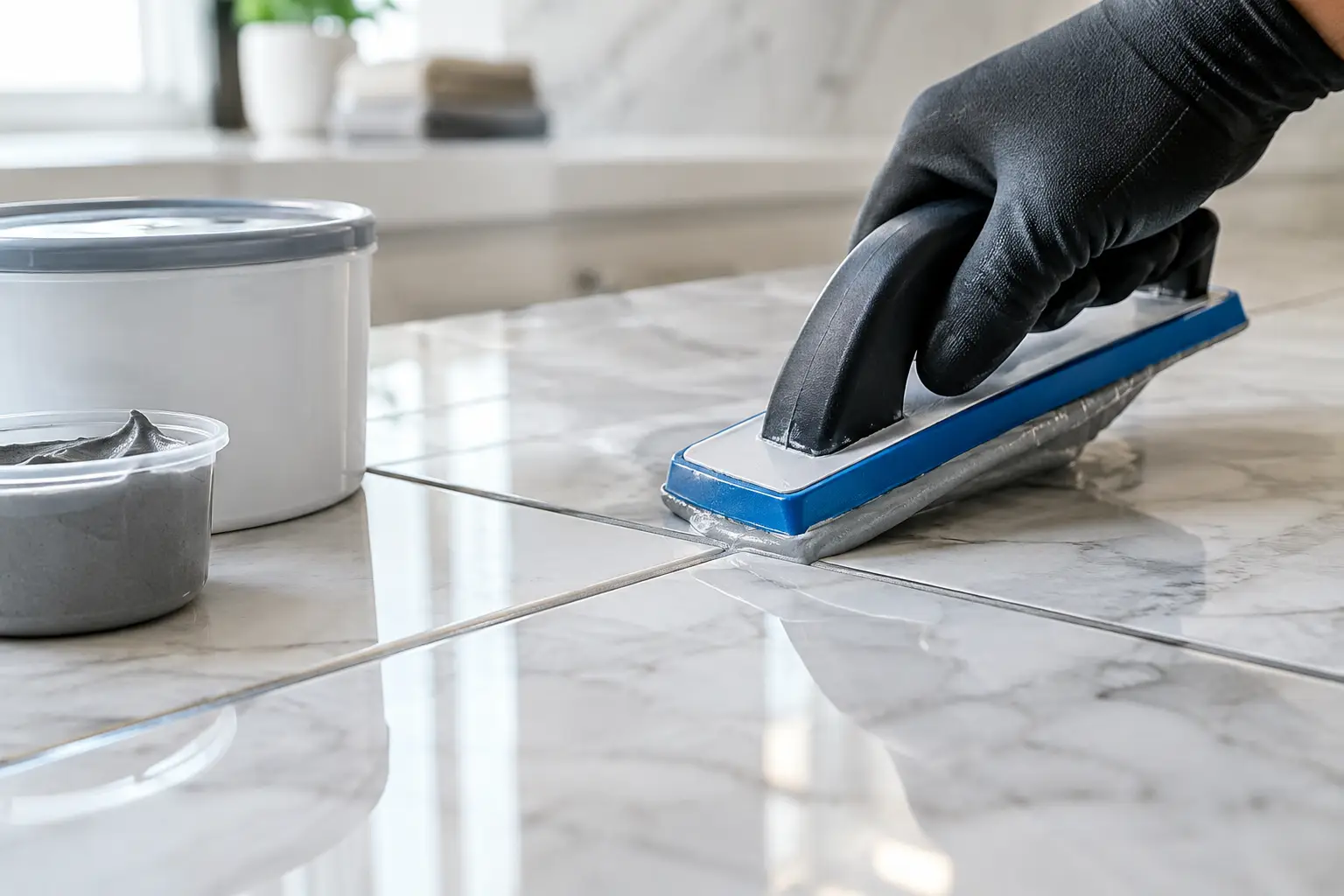
Epoxy grout is a specialist material. It has a shorter working window than standard grout and becomes difficult to remove once it starts to cure. The installer must work methodically, clean the tile surface at exactly the right stage and manage the material in smaller batches. Poor technique can leave haze, uneven joints or residue that is extremely time-consuming to rectify.
This is why epoxy grout generally costs more in both material and labour. The product itself is more expensive, and the installation process is slower and more exacting. On detailed work, such as mosaics or textured tiles, the additional labour can be considerable.
That cost should be viewed in context. Choosing epoxy for every tiled surface simply because it is premium may not be the most efficient use of a project budget. Equally, choosing standard grout in a hard-working shower or commercial kitchen solely to reduce the upfront spend can lead to more cleaning, earlier refresh work and a finish that no longer matches the rest of the project.
There are also aesthetic considerations. Modern epoxy grouts are available in a broad range of colours and finishes, but their texture and final appearance can differ slightly from a traditional cement grout. Samples and mock-ups are worthwhile when grout colour is a defining part of the design, particularly alongside handmade, honed or heavily textured tiles.
Preparation still determines the final result
No grout can compensate for inadequate preparation. Tile substrate movement, poor falls to drainage, incorrect adhesive coverage or insufficient waterproofing will remain serious issues regardless of whether the joints are filled with epoxy or cement grout.
Premium tiling begins well before the grout stage. Floors may need levelling or screeding to achieve a flat plane. Wet areas require compliant waterproofing and carefully formed falls. Tile layout needs to be resolved before fixing so cuts, joints and feature details appear intentional. Movement joints and flexible sealant must be used where appropriate, rather than being filled with rigid grout.
These details are where craftsmanship protects the finished space. Epoxy grout performs best when it is the final part of a disciplined installation process, not a product expected to rescue shortcuts made earlier in the build.
A note on corners and movement joints
Internal corners, changes of plane and movement joints should generally be finished with a suitable flexible sealant, not epoxy grout. Walls and floors move independently as buildings settle, temperatures change and materials expand or contract. A rigid grout joint in these locations is more likely to crack.
Colour-matched silicone or an appropriate sealant gives these junctions the flexibility they need while preserving a clean, considered finish. It is a small detail, but one that separates a surface that merely looks good on completion from one designed to perform properly.
How to decide whether epoxy grout is the right investment
Start with the room rather than the product. Consider how often the area will get wet, what may be spilled on it, how heavily it will be cleaned and whether the grout colour is likely to show marks. Then consider the tile itself. Small mosaics, pale grout, textured porcelain and natural stone all bring their own installation requirements.
Epoxy grout is usually worth prioritising where failure or staining would be highly visible and costly to address: shower floors, family bathrooms, kitchen floors, laundries, hospitality spaces and commercial washrooms are strong examples. It is also a sensible investment where the project has been designed around a precise, elevated finish and the client expects that standard to last.
For lower-risk areas, a high-quality cement grout may be the more proportionate choice. The key is not treating grout as an afterthought. It should be selected alongside the tile, adhesive, waterproofing and finishing sealants as part of one considered specification.
The right grout choice is the one that respects both the design and the way the space will be lived in. When durability, easy maintenance and lasting visual clarity are priorities, epoxy grout is often a worthwhile detail that keeps exceptional tilework looking exactly as it should.