Outdoor tile drainage falls done properly
A patio that looks flawless at handover can still fail in slow motion. It starts with a faint tide mark after rain, then a slippery film that never quite dries, then grout that darkens along the same lines. Most of the time the tiles are not the problem – the falls and the drainage strategy underneath are.
Outdoor tiling is judged in sunlight, not downlights. Every ripple in a plane, every awkward cut around a drain, every puddle that sits where the furniture goes becomes part of daily life. Getting outdoor tile drainage falls right is the quiet difference between an alfresco that feels resort-grade and one that constantly asks you to “manage” it.
What “outdoor tile drainage falls” really means on site
Falls are simply the deliberate slope that moves surface water to a drainage point. Outdoors, that sounds straightforward until you factor in door thresholds, structural slabs that are already poured, balcony edges, adjacent landscaping levels, and the fact that tiles are unforgiving at showing even minor inconsistencies.
When people talk about outdoor tile drainage falls, they are usually bundling four separate decisions into one phrase: where water is allowed to go, how fast it gets there, how the surface plane is shaped to guide it, and how the system behaves when leaves, wind-blown debris, or intense rainfall turn “normal” drainage into a stress test.
A well-designed fall does not just prevent puddles. It reduces staining, slows algae growth, protects grout from staying saturated, and takes pressure off movement joints and waterproofing layers. Put simply, it keeps your outdoor area cleaner, safer, and better-looking for longer.
Why outdoor falls are less forgiving than indoor floors
Indoors you can often hide marginal levels with skirtings, shower screens, or strategic lighting. Outdoors you are working with long sight lines and hard edges – doors, copings, balustrade bases, and perimeter trims that all expose whether the plane is true.
Then there is water volume. A shower delivers a predictable flow in a contained area. A downpour across a balcony or terrace can dump a large amount of water quickly, with wind pushing it sideways, and with debris trying to block the very outlet you are relying on.
Finally, outdoor finishes see thermal movement. Sun heats tiles and substrates rapidly, then temperatures drop overnight. That expansion and contraction is normal, but it means the build-up needs disciplined preparation and correct joints. If water is also sitting on the surface, you compound the risk of grout cracking, efflorescence, and long-term debonding.
Getting the fall right starts before a single tile is laid
Falls are not something you “make up” with adhesive. Adhesive is for bonding, not shaping large-scale geometry. If you are relying on thick adhesive beds to create slope, you are already compromising coverage, curing, and long-term stability.
A proper approach begins with levels and a clear water path. You set the critical heights first: the finished floor level at door sills, the maximum build-up you can accommodate, and the drain or edge condition where water will discharge. From there you can work backwards to determine whether you need a screed, a re-level, a bonded ramp, or localised adjustments.
It is also the moment to decide whether you are draining to a channel, a point drain, a perimeter edge, or a combination. Different formats and patterns behave differently around these details. Large-format tiles can look extraordinary outdoors, but they demand more precision in substrate falls because you cannot “cheat” across short distances without creating lipping.
Typical fall rates and the real-world trade-offs
Falls are often specified as a ratio – for example 1:80 or 1:60 – which translates to a drop over distance. The best rate depends on exposure, tile type, grout width, and how much tolerance you have at thresholds.
Shallower falls can look flatter and feel nicer underfoot, but they are less tolerant of minor surface variation and more likely to hold a film of water. Steeper falls clear water faster, but can introduce visual distortion in large areas, can make furniture feel slightly “off”, and can create an uncomfortable edge condition at doorways if not managed carefully.
The point is not to chase a single magic number. It is to deliver a plane that reads cleanly, drains consistently, and respects the constraints of the building. On balconies, for example, you might be limited by door heights and membrane terminations, so the drainage strategy (and drain type) becomes even more critical.
Drain types: why the detail matters as much as the slope
A beautiful fall that leads to a poorly selected drain is still a failure. Drains are not just holes – they are interfaces between finishes, waterproofing, and maintenance.
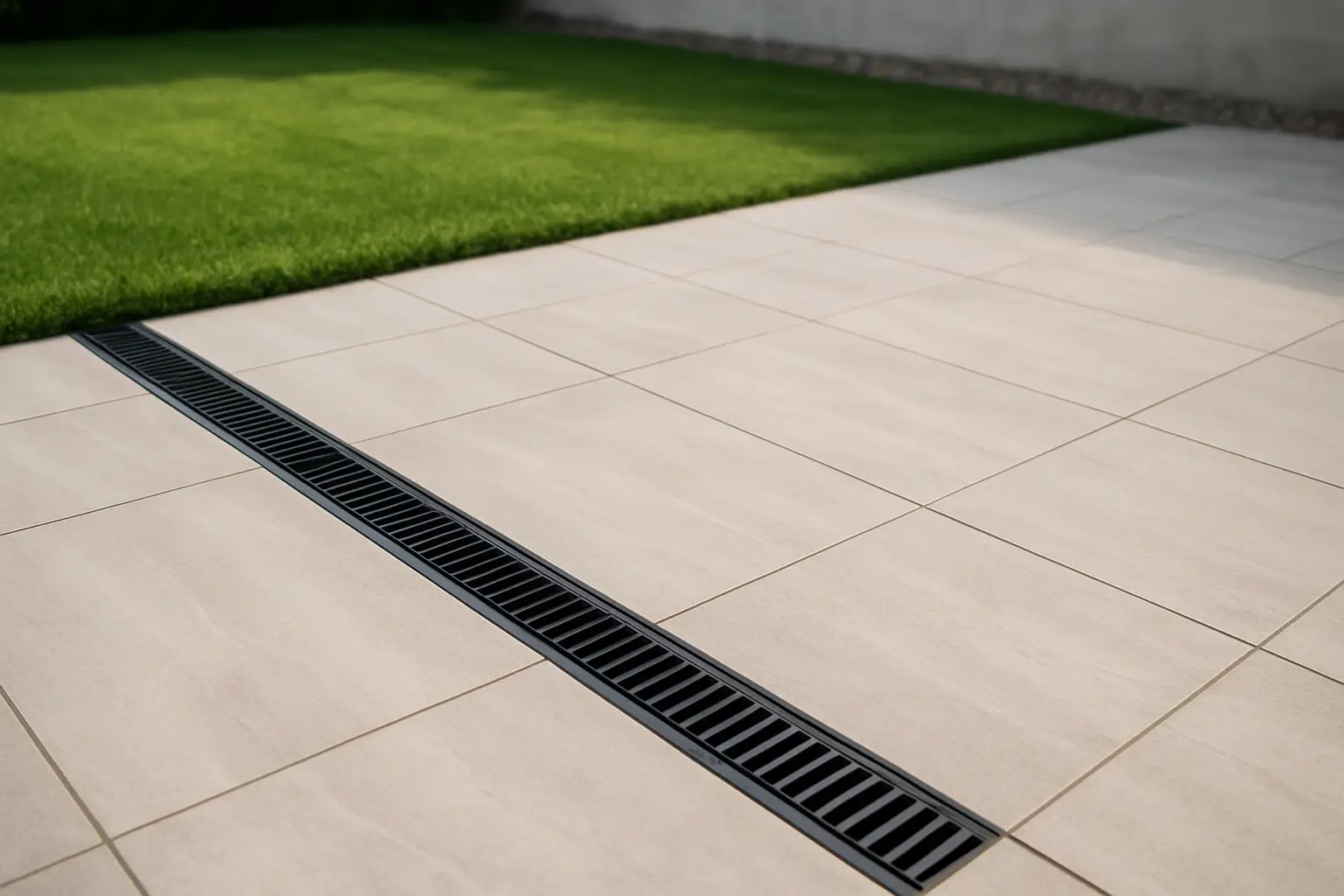
Channel drains suit long edges and door lines because they can capture water across a wider opening. They are also forgiving when rainfall is heavy, as water does not have to find a single point. The design challenge is making the channel sit perfectly straight and at the correct height relative to the tile surface, while keeping cuts clean and symmetrical.
Point drains can work well where you can create a neat four-way fall and you are comfortable with cuts converging to the grate. They can look sharp in the right layout, but they concentrate geometry in one place. If the floor is large, a single point drain may struggle in heavy rain, and if debris blocks it, ponding happens quickly.
Perimeter or edge drainage can be effective in some external zones, but it demands careful consideration of where water will go next. “Off the edge” is only acceptable when it is designed that way – not when it simply finds the easiest route and stains a façade or creates a problem below.
Balconies and podiums: waterproofing and falls must be treated as one system
Balconies, terraces, and podium decks are high-stakes because water can become a structural problem, not just a surface annoyance. The fall has to exist in the substrate so water does not sit on the membrane, and the waterproofing has to be detailed so it remains continuous at outlets, upturns, and penetrations.
This is where experienced trade sequencing matters. If the membrane is installed on a surface that is flat or back-falls towards the building, you have created a hidden bath. Even if the tile surface looks acceptable, trapped water can lead to persistent dampness, efflorescence, and eventual failure at joints.
Equally, you cannot “fix” falls by feathering a layer over a membrane without understanding compatibility and thickness limits. Outdoors, every layer has to be purposeful: substrate, falls, waterproofing, drainage interface, bonding, tile, grout, and flexible joints.
Common failure patterns we see – and what they usually trace back to
Ponding in the same spots after every rain usually signals one of two things: the substrate plane was not formed accurately, or the drain height was set too high relative to the finished tile. Sometimes it is both.
Dark grout lines that never fully dry often point to water lingering on the surface or sitting within the system. That can come from insufficient falls, but also from poor drainage design where water cannot escape quickly, especially around channels that are not cleaned out regularly.
Cracked grout or loose tiles at the edges are frequently about movement and restraint. Outdoor areas need correctly placed movement joints, and perimeter edges must allow for expansion. When water is also present, micro-movement becomes macro damage.
And then there is staining. Outdoor porcelain is generally low-porosity, but grout and certain natural stones can take on marks from tannins, soil, and standing water. Good falls reduce dwell time and make routine cleaning genuinely routine.
Planning tips for homeowners, builders, and project managers
If you are at design or pre-construction stage, you have leverage. Ask where the water goes, not just where the tiles go. Confirm the drain type early because it affects set-downs, thresholds, and the look of the finished surface.
If you are renovating and dealing with an existing slab, be honest about constraints. Sometimes the most “premium” choice is not the largest tile or the thinnest grout line – it is the system that allows correct falls without compromising waterproofing or door clearances.
For multi-unit work, consistency is the real luxury. Repeating balcony details across levels demands a disciplined approach to set-downs, drainage locations, and tolerances so every unit performs the same way and the façade reads cleanly.
When you want outdoor areas executed with that level of precision – from preparation and falls to waterproofing and finishing – a specialist tiling contractor such as Perfectly Laid focuses on the details that keep surfaces both exquisite and dependable.
The detail that separates “looks good” from “drains well”
The best outdoor tiling does not announce the engineering behind it. You do not notice the fall because the plane is calm, the cuts are balanced, and the drain sits exactly where it should. After rain, the area clears without leaving a patchwork of puddles and streaks.
That outcome is never accidental. It is surveyed, set out, formed, waterproofed, and finished with intent – and it is checked with water, not hope. If you are investing in an outdoor space you plan to live on, treat falls and drainage as part of the design, not an afterthought. Your future self, stepping outside after a storm to a clean, dry surface, will feel the difference straight away.