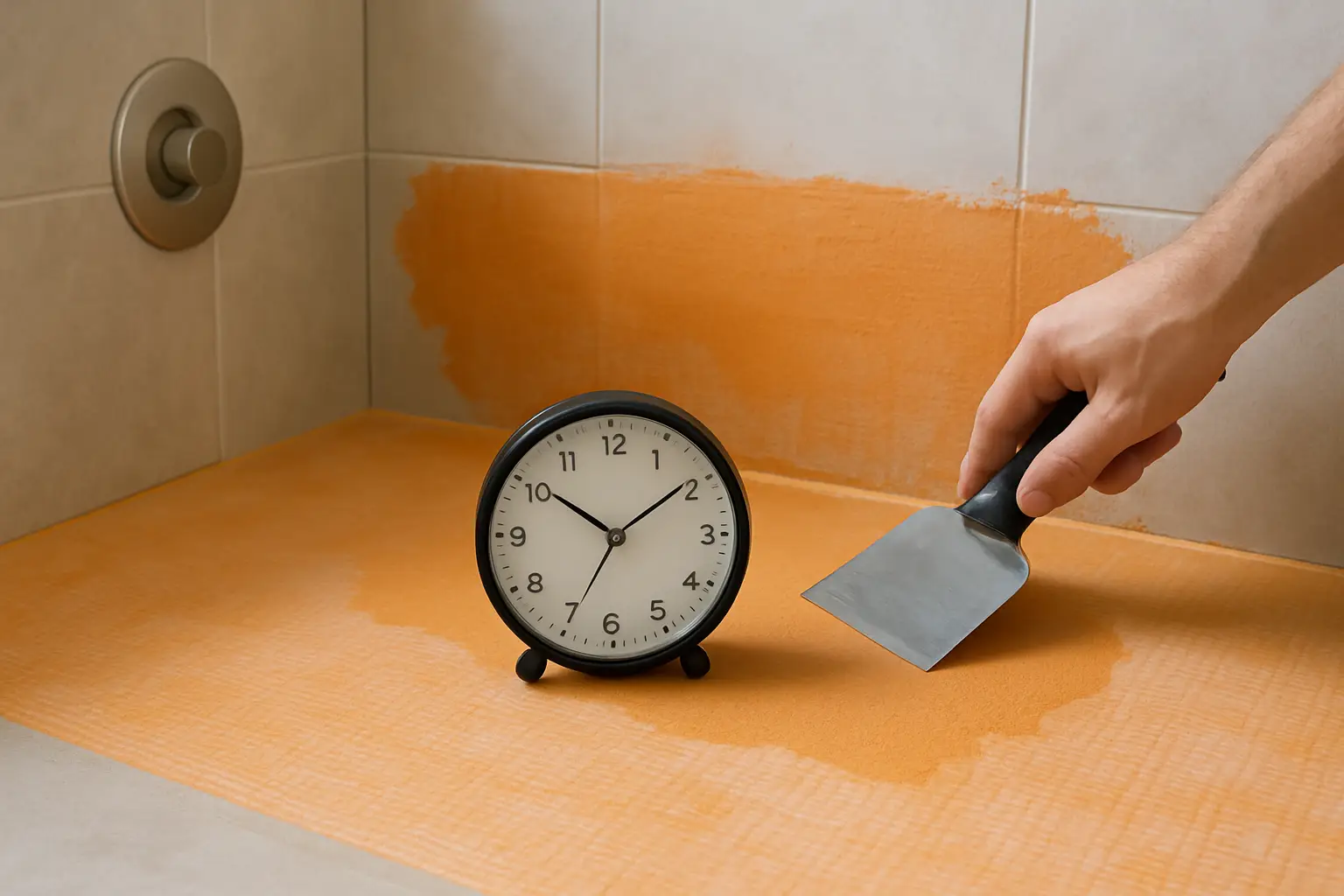
Shower Membrane Drying Time: What Really Matters
That moment when a bathroom programme looks perfect on paper – demo on Monday, waterproof Tuesday, tiles down Wednesday – is exactly when showers fail.
Most leaks we’re called to diagnose don’t come from a dramatic tear in the membrane. They come from a quieter problem: the waterproofing never had the right drying and curing window before it was covered up. Once tiles are on, you’ve locked in moisture, solvent, or uncured polymer beneath a hard finish. The shower may look exquisite, but it’s now relying on chemistry that never got the chance to complete.
This is why shower waterproofing membrane drying time is not a throwaway detail. It is the hinge between a bathroom that performs for years and one that starts to show symptoms – swelling skirting, dark grout lines, a musty smell – far earlier than it should.
Shower waterproofing membrane drying time: drying vs curing
On site, people use “drying” as shorthand for “ready to tile”. Manufacturers don’t always mean the same thing.
Drying usually refers to the surface no longer being wet to the touch. Curing is the point where the membrane has developed the mechanical strength and water resistance it was designed for. Many membranes feel dry long before they’re properly cured – especially in warm rooms or when air movement is high.
The practical takeaway is simple: tiles and adhesives don’t care if the membrane feels dry. They care whether the membrane has cured enough not to re-emulsify, blister, or stay soft under load.
What affects membrane drying time in a shower?
Membrane systems are engineered, but bathrooms are messy variables. Two showers in the same house can behave differently if one is on an external wall or gets morning sun.
1) The type of membrane system
Most domestic showers use either a liquid-applied membrane (roll-on or trowel-on) or a sheet membrane. Each behaves differently.
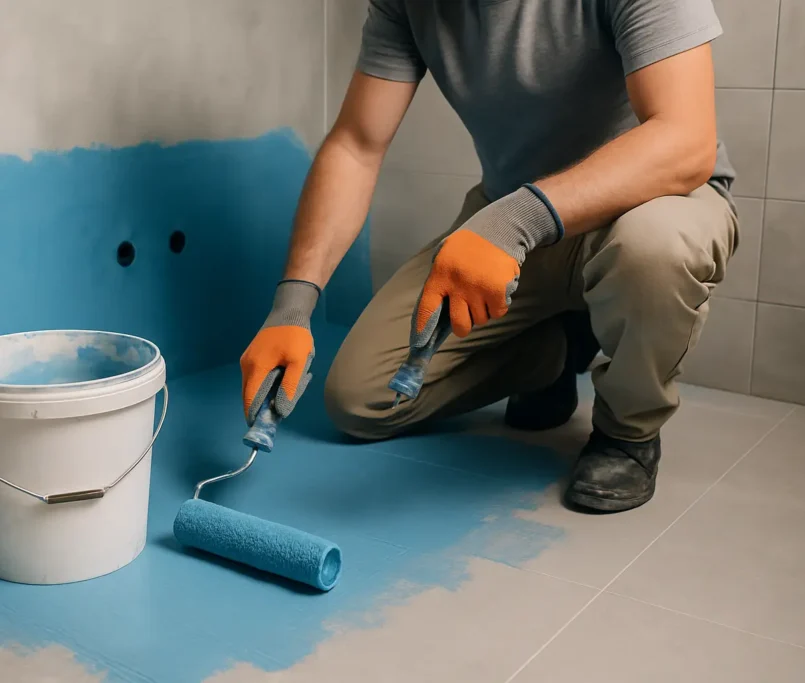
Liquid membranes depend on film formation. That can be water-based evaporation, chemical crosslinking, or a bit of both. They are sensitive to thickness and environment. Sheet systems rely less on “drying”, but their adhesives, overlaps, primers, and detailing components still have cure requirements that control when you can tile and flood test.
2) Film thickness and number of coats
The quickest way to stretch a drying time is to apply a coat too thick, or to apply the second coat before the first has stabilised.
A thick coat can skin over on top while staying wet underneath. Then the next layer traps that moisture. The surface looks ready, but you’ve created a slow-cure sandwich that can blister once heated or once tile adhesive starts pulling moisture.
3) Temperature, humidity, and ventilation
Bathrooms are naturally humid spaces, and waterproofing is often done before mechanical ventilation is commissioned.
Warmth helps, but not if the air is saturated. High humidity slows evaporation and can keep water-based membranes “green” for far longer than expected. Conversely, very cold conditions can stall curing, leaving the membrane soft even days later.
Ventilation matters because it replaces moist air with drier air. It’s not about blasting a heater and hoping for the best. It’s controlled airflow, stable temperature, and time.
4) Substrate moisture and preparation
If the substrate is damp, the membrane is fighting from the start.
New screeds, patch repairs, or freshly levelled floors often hold residual moisture. If you waterproof too early, the membrane may be forced to cure against a wet base. That can cause weak adhesion, pinholes, or prolonged drying times – and the problem may only reveal itself after the shower has been put into service.
5) Detailing complexity
Corners, niches, step-downs, benches, and multiple penetrations are where precision workmanship pays for itself.
These areas usually require bond breakers, reinforcing fabric, extra coats, or specialised collars. Each layer adds time. Trying to “save” a day here often costs weeks later.
Realistic timeframes (and why generic numbers mislead)
If you’re looking for one universal number, there isn’t one. Product chemistries vary, and so do site conditions.
That said, most quality systems land in these broad, real-world windows:
Liquid-applied membranes are commonly ready for a second coat later the same day or the next day, depending on conditions. They may be ready to tile the following day in ideal conditions – but “ideal” usually means a warm, dry room with good ventilation and correct film build.
Flood testing, where required or specified, is commonly not the same as “ready to tile”. Many systems require a longer cure period before a sustained water test is performed, particularly in cooler or more humid environments.
Sheet membranes can allow earlier tiling in some cases, but only when primers and adhesives have set correctly, detailing is complete, and the substrate is suitable. A sheet is not a shortcut if the base is still damp, the screed is green, or the adhesive bed hasn’t stabilised.
The disciplined approach is to treat manufacturer data as a starting point, then adjust for your actual site conditions rather than the schedule you wish you had.
The hidden risks of tiling too soon
When a shower fails, it rarely announces itself on day one. Early tiling simply loads the system before it has matured.
You can end up with:
- Loss of bond between membrane and substrate, or between tile adhesive and membrane, leading to drummy tiles or movement
- Blistering or bubbling as trapped moisture or solvent tries to escape
- Soft or damaged membrane under point loads (especially at corners and around wastes)
- Compromised lap joints and penetrations that look fine until repeated wetting begins
If you’re delivering a premium bathroom – the kind where mitres are crisp, falls are accurate, and the grout lines are perfectly balanced – it’s counterproductive to gamble the waterproofing stage for the sake of a fast finish.
How we judge readiness on site (without guesswork)
There’s a difference between being cautious and being vague. Readiness can be assessed.
We start by controlling what we can: correct priming, correct coat thickness, and consistent application. Then we look at conditions in the room – temperature, humidity, airflow – and we keep the bathroom stable rather than swinging between cold nights and hot afternoons.
We also pay attention to the membrane itself. A uniform colour change (where applicable), no tackiness, no soft spots at corners, and no milky patches are practical indicators. The most telling areas are the hardest ones: internal corners, around penetrations, and at the puddle flange. If those are still curing, the field area is not the deciding factor.
Finally, we follow the system. Waterproofing is not just a liquid in a bucket. It’s primer, bond breakers, reinforcement, coat build, cure time, and then testing where required. When it’s treated as a system, the finish becomes predictable.
Getting the programme right on premium and multi-unit projects
Homeowners often feel the pressure because one delay seems to knock the whole renovation off track. Builders and project managers feel it at scale, where a day’s slip across multiple bathrooms becomes a major cost.
The answer isn’t to rush the membrane. It’s to plan sequencing properly.
If you want reliable turnaround, you build curing time into the programme from the start and you keep conditions consistent. You also avoid stacking trades on top of each other in the same space. Plumbers coming back to adjust fittings after waterproofing, other trades dragging ladders through wet areas, or last-minute chasing in walls – these are all schedule killers because they force rework and restart cure clocks.
On high-end projects, the finish quality is only as strong as the discipline behind it. That’s where a quality-first tiling contractor earns their keep: by making the waterproofing stage boring, controlled, and repeatable.
For clients who want that level of process and predictability, Perfectly Laid approaches waterproofing as a critical performance stage, not a box to tick before the tiles go on.
Common scenarios where drying time changes dramatically
Some bathrooms behave “normally”. Others don’t.
If you’re working in winter conditions, expect cure times to extend, sometimes materially. A membrane that behaves in a day during a warm spell can take significantly longer in a cold, closed-up property.
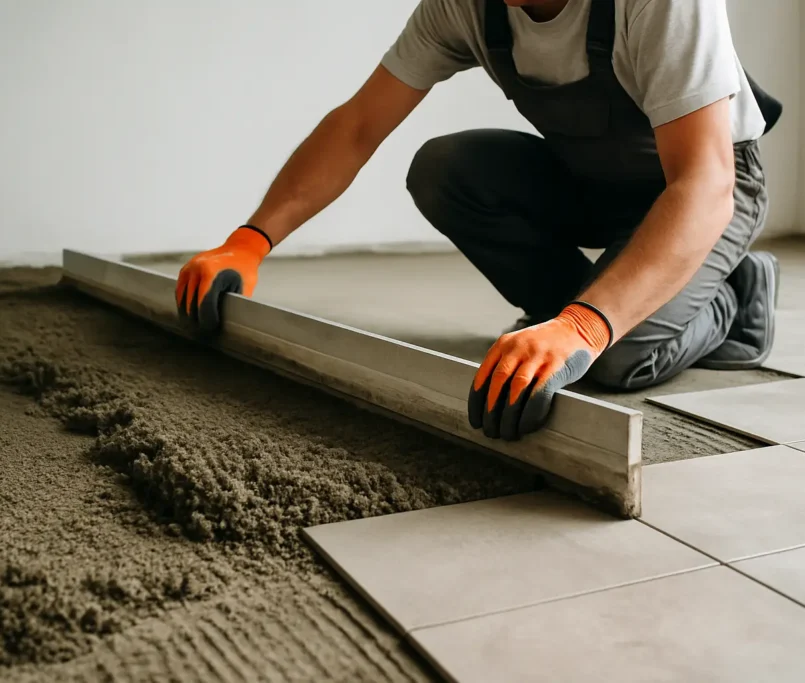
If the shower is over a new screed or fresh levelling compound, the substrate may still be releasing moisture. Even if the surface looks dry, the base can be holding enough moisture to slow the membrane’s cure and increase the risk of later issues.
If the design includes niches, benches, or a linear drain with complex junctions, build more time into detailing and curing. These are the areas that protect the building fabric, and they’re the hardest to repair once tiled.
Closing thought
A premium shower isn’t defined by a tile brand or a trendy colour choice. It’s defined by what you never see: a membrane that was applied with precision, allowed to cure properly, and only then covered with a finish worthy of the space. Give the waterproofing the time it’s asking for, and the rest of the bathroom gets to shine – without unpleasant surprises waiting behind the grout lines.